President Donald Trump has spent months aggressively pushing Federal Reserve Chairman Jerome Powell to cut interest rates. But 21 days into the war in Iran — with no end in sight — the bond market is starting to scream what Trump would never have expected to hear.
A rate hike.
Short-term interest-rate futures are now pricing chances of a Federal Reserve rate hike before the end of the year. Less than three weeks ago, markets had 60 basis points of cuts on the table.
The Iran war has not just reversed that assumption — it has flipped it.
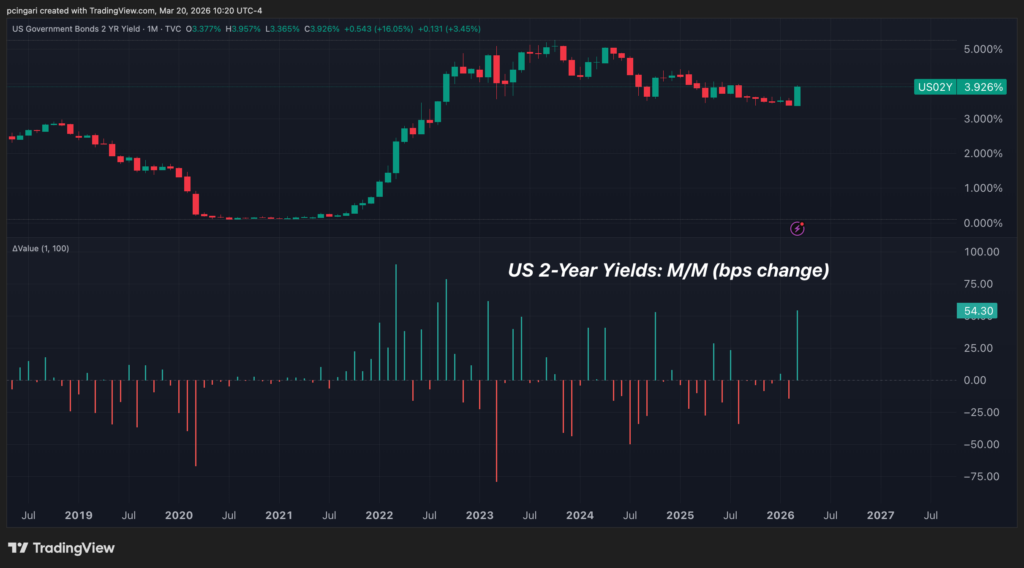
US 2-Year Yields Spike The Most In Over 2 Years: Why It Matters
On Thursday, the yield on the 2-year Treasury note surged 12 basis points to 3.92%, marking its sharpest single-day increase since April 2025.
The move caps a powerful repricing. On a monthly basis, 2-year yields have risen 54 basis points — the largest increase since February 2023, when the Fed was deep into its most aggressive tightening cycle in four decades.
As a key proxy for near-term interest rate expectations, the 2-year yield is now signaling a shift in market pricing — with investors increasingly factoring in the risk of renewed rate hikes.
When rate hikes become the base case, rate-sensitive equities — such as the Invesco QQQ Trust (NASDAQ:QQQ) — tend to come under heavy pressure, much like they did during the 2022 tightening cycle.
The Rate Hike Odds That Nobody Expected Three Weeks Ago
Polymarket’s Fed rate hike market for 2026 has jumped to a 24% probability. Before the war started, the probability of rate hike was as low as 6%.
The CME FedWatch tool now shows a 40% chance of at least one rate hike by October. And short-term rate futures have effectively priced out all remaining easing for the year.
The speed of the repricing is as striking as the direction. At the start of March, the Federal Reserve was expected to deliver two to three rate cuts in 2026.
That consensus has been dismantled in less than three weeks by a single variable: the price of crude oil.
BofA Sets Bar For What It Would Actually Take For The Fed To Hike
Bank of America economist Aditya Bhave published a note Thursday laying out the three conditions the Federal Reserve would need to see before seriously putting rate hikes on the table.
- Labor Market Stability: In 2022, the Fed hiked through a technical recession because the unemployment rate was below 4% and falling. Modest payroll growth, steady jobless claims, and a stable job openings rate would support the case.
- Core Inflation Breakout above 3.2%: A 10% rise in WTI adds roughly 7 basis points to core inflation over time. If the Iran shock broadens into shipping, natural gas, fertilizers, and aluminum — a 2021–22 style supply disruption — 3.2% becomes reachable.
- Powell Still At The Helm: Fed nominee Kevin Warsh has not yet been confirmed. Bank of America views Powell as a moderate dove who would prioritize the labor market if risks are balanced — but far more hawkish than incoming nominee Warsh, whose recent comments have stressed urgency to cut. June is the earliest meeting at which hikes could begin, and only if Powell is still chairing.
His conclusion: it would take a lot, but the conditions are not out of reach.
The April 10 CPI report is now the most consequential data release in years. If it prints at 3.4% or above, the conversation shifts from whether the Fed can hike to when.
Image: Shutterstock
Login to comment