It’s been a quarter to forget for many sectors in the U.S. stock market, but none have had it worse than the banking industry.
Financials are the worst-performing sector year to date (YTD), with the Financial Select Sector SPDR Fund (NYSE:XLF) down more than 10% so far in 2026. The sector has been hit by a series of headwinds, many of which weren't on investors’ radar when the year began.
For starters, the war in Iran has thrown new wrenches into the Federal Reserve's path for interest rates. While investors began the year with multiple rate cuts penciled in, the oil shock has the Fed back on pause, and only 25 basis points of cut are now projected for 2026.
And some analysts are even pushing back on that, including JPMorgan economist Michael Feroli, who predicts zero cuts this year.
With the threat of stagflation and private credit contagion also rising, banking stocks are facing a swift but serious repricing to reflect higher rates, stickier inflation, and slower growth.
Here are five stocks you'll want to avoid as the new rate environment comes to fruition.
Wells Fargo and Co.
Wells Fargo (NYSE:WFC) stock was already stuck in a range-bound trading funk as it awaited several catalysts to emerge in 2026. But most of those catalysts are now stuck in neutral, and the stock has plummeted in the first quarter of the year. For starters, Wells Fargo's asset cap was lifted by the Fed last year, after seven years of restrictions following the company's fake-accounts scandal. Wells Fargo was projecting a return to growth with the cap lifted and interest rate cuts on the table, but now the growth environment is failing to materialize.

With the growth story looking like a bust, Wells Fargo stock has already lost more than 15% in Q1, and technical signals point to strengthening bearish momentum. The drawdown has seen shares give up the 50-day and 200-day moving averages, with a plummeting Moving Average Convergence Divergence (MACD) indicator confirming the trend. The Relative Strength Index (RSI) also hasn't reached the oversold threshold yet, indicating that there still could be more downside ahead.
Silver Is Moving Fast — The Setup Most Traders Are Missing
Silver's recent move is unfolding alongside broader shifts in oil, inflation, and global markets, creating short windows where positioning matters. Matt Maley recently stepped into that move in SLV and will walk through the setup, the signals behind it, and where he's seeing the next opportunities forming right now. Register Free
Bank of America Corp.
Bank of America (NYSE:BAC) is under a unique amount of pressure because of all the large-cap bank stocks, its bond portfolio has one of the longest average durations. The company increased its long-term bond holdings during the previous era of low rates. But now that rates are expected to remain higher for an extended period, these bonds represent a risk to the bank's balance sheet and could result in losses if the portfolio needs to be restructured. Bank of America had already delivered tepid guidance while reporting Q4 2025 earnings in January, and now the situation has deteriorated even further.
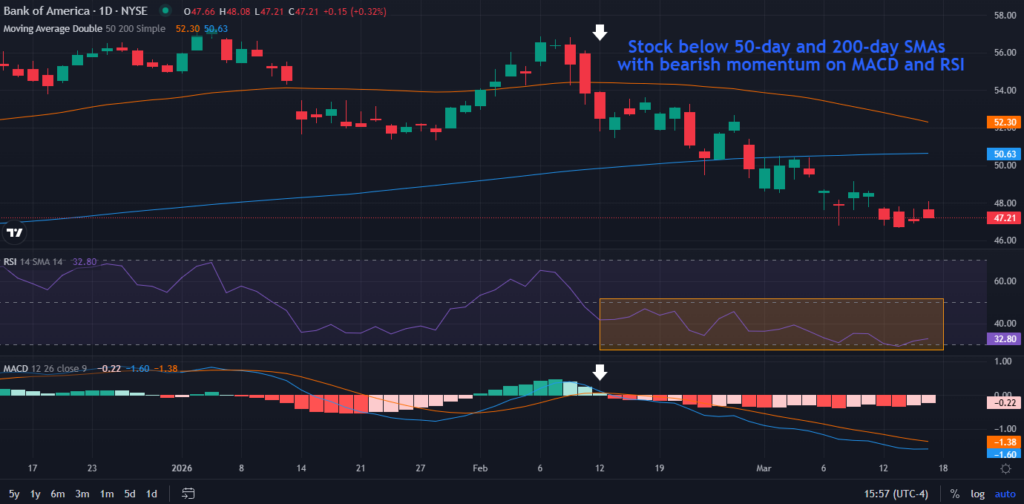
BAC has been riding the elevator down over the last few weeks, breaking through the 50-day and 200-day MAs following a bearish MACD crossover. The RSI is also continuing its descent, but hasn't reached the oversold level with the type of velocity that can produce a reversal.
East West Bancorp Inc.
East West Bancorp (NASDAQ:EWBC) shares are down nearly 15% in the last month, in part due to the company's commercial real estate (CRE) exposure and dependence on cross-border U.S. and Chinese investment. Despite the removal of most of the Trump administration's tariffs, trade between the U.S. and China remains tenuous and unpredictable. Until China tensions are resolved, East West Bancorp could face exacerbated risks if the market environment for banks continues to deteriorate.

EWBC shares notched an all-time high as recently as mid-February, but the trend has quickly shifted. The stock is now trading below the 200-day moving average, which could be forming a new resistance area. A bearish MACD cross confirms the trend shift, and the RSI is still bouncing above oversold territory.
Bank OZK
Bank OZK (NASDAQ:OZK) has significant exposure to CRE assets and has begun writing off some of its loans, including a $72 million charge-off in Q4 2025 for its East Cambridge, MA project. Instability is the last thing a regional midcap bank needs at the present moment, with rates remaining higher and loan demand beginning to dry up. The stock has also seen its short interest steadily rise in 2026, and now sits at 15.17% of the float, the highest level since last September.

OZK shares attempted a breakout at the start of the year, but the uptrend was rejected when the 50-day MA failed to cross the 200-day MA, triggering a bearish MACD crossover. The MACD shows that downward momentum is gaining strength, and a bank with this much CRE exposure and technical headwinds seems like an overly risky investment in the present environment.
Regions Financial Corp.
Regions Financial (NYSE:RF) has a reputation as a steady, consistent midsize regional bank with a diverse footprint, solid (if conservative) underwriting, and a strong balance sheet. But that steady performance is hitting some rocky terrain: the bank's net interest income (NII) guidance for 2026 is in a tight, narrow range of 2.5% to 4%, with the potential to go actually negative in Q1. Revenue and EPS results also missed expectations in Q4 2025, but the stock didn't start feeling pressure until rate concerns began to materialize in late February.

RF shares were a big winner in the second half of 2025, nearly doubling from $18 to $32 following the April Liberation Day lows. But now the stock has been one of the quickest to drop in the banking sector, posting a 15% loss in the last 30 days alone. The technical trends are looking poor for the stock as well now that the 50-day moving average support level has been broken. Shares now trade below the 200-day moving average, with bearish momentum continuing to grow on the RSI and MACD, which, for many investors, was likely unthinkable just three months ago. Despite the drawdown, RF shares are still expensive for a regional at 11 times earnings and 3 times book value.
Login to comment