President Donald Trump promised to slash beef prices on day one of his election. Eighteen months later, cattle and retail beef prices have reached record highs.
At $6.74 per pound, the current price of beef is about 18% higher than it was during President Joe Biden‘s last year in office. cattle and beef prices have sharply outperformed the U.S. stock market — and the structural shortage driving them shows no sign of relenting.
Since Trump’s election victory on November 5, 2024, feeder cattle futures have surged 51.85% and live cattle 33.09% — more than tripling and doubling the S&P 500’s — as tracked by the SPDR S&P 500 ETF Trust (NYSE:SPY) — 17.22% return over the same period.
While Wall Street convulsed over Trump’s tariffs and the war in Iran, cattle were quietly minting returns that would embarrass an AI-linked portfolio.
Notably, the outperformance holds across recent years. Over four years, feeder cattle futures gained 131% and live cattle 84%, against 51% for the S&P 500.
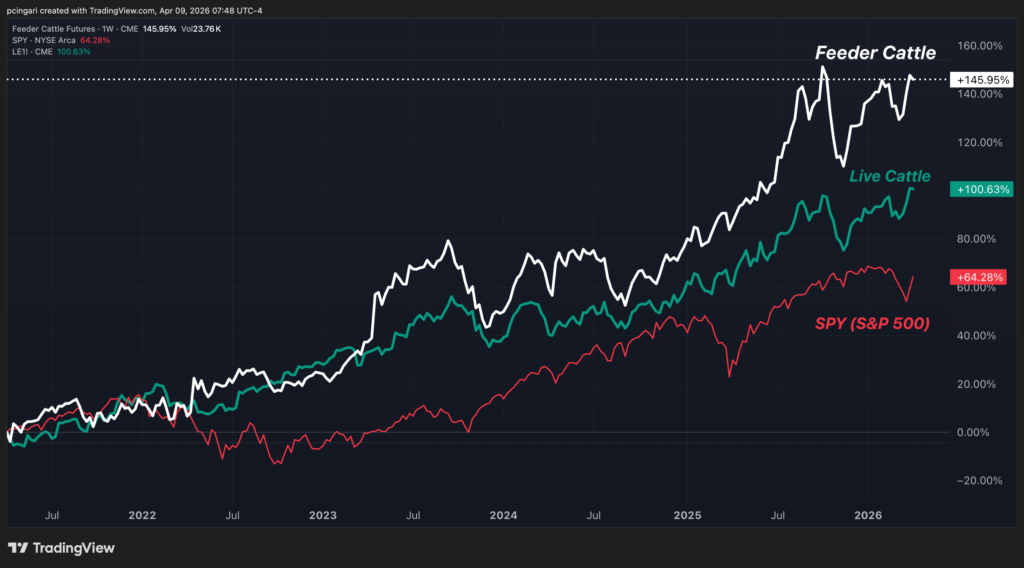
Stretch to five years: feeder cattle 146%, live cattle 101%, SPY 64%. Compress to two: feeder cattle still lead at 55% versus 30% for SPY.
| Period (through April 8, 2026) | Feeder Cattle Futures (GF!) | Live Cattle (LE!) | SPY |
|---|---|---|---|
| YTD | +4.30% | +4.21% | -1.05% |
| Since Trump election (Nov 5, 2024) | +51.85% | +33.09% | +17.22% |
| 2-year | +55.16% | +41.89% | +30.32% |
| 3-year | +78.97% | +50.23% | +65.00% |
| 4-year | +130.90% | +83.77% | +51.04% |
| 5-year | +145.96% | +100.60% | +64.00% |
Chart: Feeder Cattle Has More Than Doubled S&P 500 Returns In 5-Year Window
The Smallest Herd Since 1951
The U.S. cattle herd — the total count of all cattle and calves — stood at 86.2 million head as of January 1, 2026, according to the U.S. Department of Agriculture.
That is a 75-year low, down from a recent peak of 94.7 million in 2019.
The herd has been contracting for eight consecutive years and will not meaningfully expand before 2028 at the earliest.
Think of it like a factory that keeps idling production lines while customers keep ordering the same number of burgers. Eventually, the backlog becomes structural, and price is the only clearing mechanism.
The cattle cycle — a natural 8-to-12 year rhythm of herd expansion and contraction driven by prices, drought and gestation periods — has entered its 13th year of the current cycle and its eighth year of contraction.
Because a cow takes nine months to gestate and another 18 to 24 months to reach slaughter weight, there is no quick fix.
Each year of delay compounds the next.
Three Shocks, One Direction
In early 2026, the cattle market absorbed three simultaneous blows — each independently bullish, collectively historic.
The U.S. reinstated a suspension on cattle imports from Mexico in May, after New World Screwworm cases were detected as far north as the Mexican states of Oaxaca and Veracruz.
Mexico historically supplies about 62% of all U.S. live cattle imports, predominantly lightweight feeder cattle destined for U.S. stocker and feedlot operations.
Wildfires across the Nebraska plains wiped out grazing land and forced cattle to market early, tightening the forward supply pipeline.
Then in March, approximately 3,800 workers at the JBS N.V. (NYSE:JBS) packing plant in Greeley, Colorado went on strike, idling a facility that handles roughly 5% to 7% of total U.S. beef slaughter capacity for three weeks.
The USDA’s March 2026 outlook lowered the 2026 beef production projection by 110 million pounds from the prior month to 25.810 billion pounds, citing a sharp decline in fed cattle slaughter expected in the first quarter.
According to Russell Knight, agricultural economist at USDA, slaughter steer prices are now forecasted to reach $242.00 per hundredweight (cwt) and feeder steer prices to $367.25 per cwt this year.
Beef imports were raised to 5.675 billion pounds while export forecasts were cut to 2.395 billion pounds — a sign that record-high domestic prices are pricing U.S. beef out of overseas markets even as the country relies increasingly on imports to fill the supply gap.
FCS America projects available fed cattle supplies in the first quarter of 2026 to run 6% to 7% smaller than a year prior, with the choice cutout averaging between $375 and $385 per cwt and fed cattle prices between $234 and $238 per cwt.
“Consumer beef demand and spending remain strong and supportive of cattle prices,” Terrain's senior animal protein analyst Dave Weaber said, adding that “presidential and executive branch rhetoric about lowering beef prices has had little to no impact on retail and wholesale beef prices.”
Image: Shutterstock
Login to comment