Ethereum (CRYPTO: ETH), the second-largest cryptocurrency by market cap at $240 billion, has been losing ground. Trading at $1,987 at the time of writing, ETH has shed more than 50% of its value since hitting an all-time high of $4,955 in August 2025. The slowdown can be attributed to different reasons; here are the major ones, and what could change the outlook.
Leadership Uncertainty at the Ethereum Foundation
The Ethereum Foundation has been undergoing a significant restructuring. In January 2025, Vitalik Buterin confirmed the organization was moving toward a smaller, more focused role – describing it as “one node with a defined purpose” rather than a central authority. At least eight senior contributors have since departed, raising questions about leadership direction, treasury strategy, and execution pace.
For investors, prolonged internal disruption at the organisation that has historically guided Ethereum’s development creates uncertainty – and uncertainty suppresses price momentum.
Institutions Are Pulling Back
Ethereum ETF products have attracted significantly less institutional capital than Bitcoin’s. While Bitcoin ETFs pulled in $16 billion in net inflows during 2025, Ethereum ETFs averaged just $1.2 billion in daily trading volume – roughly 31% of Bitcoin ETF activity. The gap widened sharply in Q4 2025, with Ethereum ETFs recording $1.4 billion in outflows in November alone – the largest monthly exit since their July 2024 launch.
Glassnode data showed net flows for Ethereum ETFs turned negative in early November 2025 and have not recovered since. Without fresh institutional demand, there is limited buying pressure to support any meaningful price recovery.
Macro Conditions Weigh on Risk Assets
Elevated interest rates reduce appetite for speculative assets. When safer instruments offer attractive yields, capital tends to rotate away from crypto. This dynamic has hit Ethereum harder than Bitcoin. Bitcoin is increasingly treated as a macro hedge – similar to gold. Ethereum’s investment case, by contrast, is tied to network utility and growth expectations. When risk appetite shrinks, growth-narrative assets tend to underperform. Until interest rate conditions ease meaningfully, ETH is likely to remain rangebound.
Layer 2 Networks Are Capturing Ethereum’s Revenue
This is arguably the most structural challenge Ethereum faces. Layer 2 networks were designed to scale Ethereum by processing transactions off the main chain – with the expectation that ecosystem growth would benefit ETH. In practice, the economics have not worked out that way.
In 2024, Layer 2 networks paid approximately $113 million – 41% of their revenue – back to Ethereum’s mainnet. By 2025, that figure collapsed to around $10 million, less than 10% of their total revenue. The Dencun upgrade, which slashed Layer 2 transaction costs, was the main trigger. Ethereum’s daily gas fee revenue dropped from over $30 million to roughly $500,000 after the upgrade, and token burns – a key deflationary mechanism – slowed sharply.
The result is a network that is technically more active than ever, but where most of that activity generates value for Layer 2 operators rather than ETH holders. Until a credible value-capture mechanism is introduced at the protocol level, this remains a genuine drag on price.
Technical Analysis
Ethereum has been rangebound between $1,000 and $4,900 since its August 2025 all-time high of $4,955, with no significant breakout to the upside. The contrast with Bitcoin is stark. Bitcoin (CRYPTO: BTC) hit a new all-time high of $125,725 in September 2025 – nearly doubling its previous peak of $69,000 from November 2021. Despite losing more than 50% since then, Bitcoin is currently trading at $72,900 – still well above its prior cycle high. Ethereum has not achieved the same.
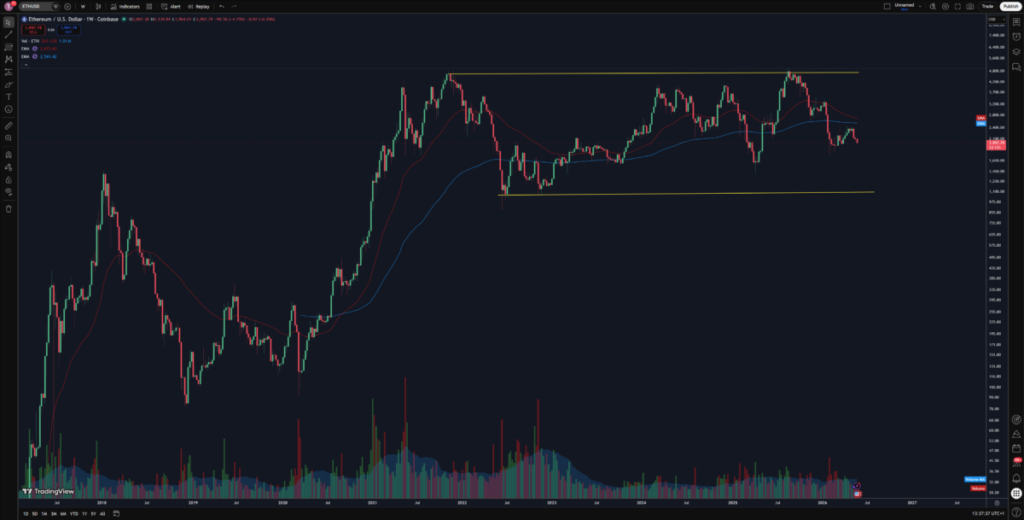
Chart: Created by the author using Tradingview.
What Could Change the Outlook
Despite near-term weakness, the long-term institutional view remains cautiously constructive. Standard Chartered revised its year-end 2026 ETH target from $12,000 down to $7,500 in January 2026, while maintaining a $40,000 target for 2030. VanEck projects a base case of $11,800 by 2030. Both forecasts imply significant upside from current levels – but are contingent on several things going right.
The most concrete near-term catalyst is a scheduled network upgrade. The Glamsterdam fork, planned for 2026, enables parallel transaction processing, raises the gas limit from 60 million to 200 million, and targets around 10,000 transactions per second – a major improvement over current throughput. A second upgrade, Hegotá, planned for H2 2026, focuses on privacy, decentralization, and censorship resistance.
If both upgrades ship on schedule, they would address two of Ethereum’s most persistent criticisms – speed and scalability – and could strengthen the investment case heading into 2027. Ethereum’s mainnet currently secures approximately 64% of the total value locked in DeFi – rising above 70% when Layer 2 assets are included. That structural entrenchment is difficult for competing networks to displace quickly. The key question is whether ETH itself captures the value generated by that activity, rather than Layer 2 operators. The answer to that question will ultimately determine whether the long-term price targets are realistic or remain theoretical.
Benzinga Disclaimer: This article is from an unpaid external contributor. It does not represent Benzinga’s reporting and has not been edited for content or accuracy.
Login to comment