Space Exploration Technologies Corp. (NASDAQ:SPCX) may be dominating Wall Street’s attention ahead of its highly anticipated market debut, but another space stock just flashed one of the most closely watched bullish technical signals.
Virgin Galactic Holdings Inc. (NYSE:SPCE), which trades around $4.34 per share, recently formed a Golden Cross after its 50-day moving average climbed above its 200-day moving average, a pattern traders often associate with the start of longer-term uptrends.
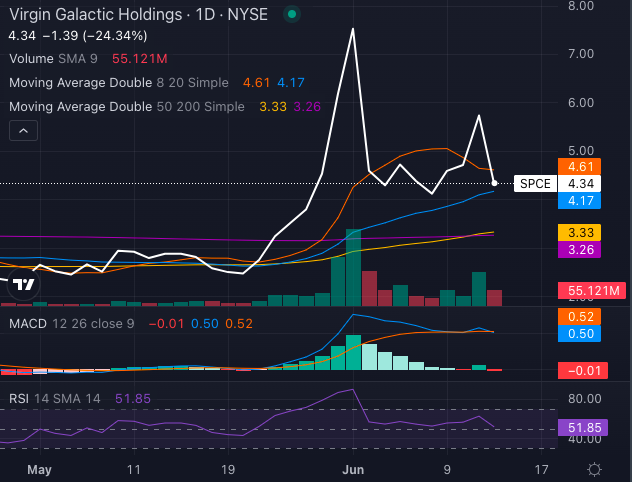
Chart created using Benzinga Pro
The signal comes as SpaceX prepares to begin trading at $135 per share or higher, potentially becoming one of the largest and most expensive IPOs in market history.
Golden Cross Setup
According to the chart, SPCE’s 20-day moving average sits at $4.17, above its 50-day moving average of $3.33. The stock remains above both trend lines despite Thursday’s pullback, keeping the bullish crossover intact.
Volume has also expanded sharply during the recent advance, with several sessions posting significantly above-average trading activity as the stock climbed more than 56% over the past month.
Momentum Indicators
Momentum readings remain constructive.
The Relative Strength Index, or RSI, stands at 51.85, suggesting the stock is neither overbought nor oversold.
Meanwhile, the MACD (moving average convergence/divergence) indicator remains in positive territory, with the MACD line at 0.50 and the signal line at 0.52. While momentum has cooled from recent highs, the indicator continues to reflect a bullish trend backdrop.
SpaceX Shadow
The timing is difficult to ignore.
As investors focus on SpaceX’s blockbuster debut, speculative interest has returned to the broader space sector. SPCE stock is up 32.67% year-to-date and 45.02% over the past year, though the stock remains well below levels reached during previous retail-driven rallies.
Whether the golden cross develops into a sustained uptrend remains to be seen. But while Wall Street debates whether SpaceX’s valuation is justified, technical traders may already be finding opportunities elsewhere in the space economy.
Photo: berni0004 / Shutterstock
Login to comment