Federal Reserve Chair Kevin Warsh used his first international appearance to reaffirm the central bank’s fight against inflation, telling a packed policy panel at the European Central Bank’s Sintra forum on Wednesday that “prices are too high,” while pointedly refusing to hand markets a signal on the July meeting.
• SPDR Gold Shares stock is moving in positive territory. Why are GLD shares climbing?
Warsh Reiterates Battle Against Inflation
Warsh shared the stage in Sintra, Portugal, with ECB President Christine Lagarde, Bank of England Governor Andrew Bailey and Bank of Canada Governor Tiff Macklem for a panel on inflation and interest rates.
It was his first public outing since chairing his debut Federal Open Market Committee meeting on June 17, where the FOMC held the funds rate at 3.50%–3.75%.
Warsh described the committee’s commitment to the 2% target as unanimous and unambiguous.
Even as he noted that inflation expectations had eased in recent weeks, he declined an invitation to label the energy-driven price spike ‘transitory.
Instead, he drew a firm line on the target: anyone in households, business or financial markets expecting the Fed to tolerate inflation above 2%, he said, “would be disappointed.”
Updating his now-famous line about meeting “in six weeks,” he quipped that the next gathering is now “in four weeks,” and said he wanted the committee to “have a good family fight” before deciding.
Asked whether the Fed would deliver on that regardless of what President Donald Trump wants, he responded by defending the central bank’s independence, saying the Fed had “been an independent central bank for a very long time” and that markets would “see no changes on that.”
Markets See Less Urgency For A July Hike
Rate-hike bets remain live but cooled after his remarks.
As of Wednesday morning, CME FedWatch put the odds of a hold at the July 29 meeting at 69.5%, against 30.5% for a 25-basis-point hike — down from about 37% a week earlier. On prediction market Polymarket, the July hike contract traded near 20%.
Further out, the market still leans toward tightening. CME FedWatch prices the probability of at least one hike by the September meeting near 77%, and above 90% by October.
Treasury yields, which had risen through the morning on a stronger-than-expected read on job openings, reversed lower as Warsh spoke: the rate-sensitive 2-year yield, tracked by traders as the cleanest gauge of Fed expectations, eased back toward 4.14% after spiking near 4.20% overnight.
The SPDR Dow Jones Industrial Average ETF Trust (NYSE:DIA) and the small-cap iShares Russell 2000 ETF (NYSE:IWM) both traded higher, with the Dow above 52,500 and the Russell 2000 up more than 0.5%. The SPDR S&P 500 ETF Trust (NYSE:SPY) held modest gains near a record.
But mega-cap tech lagged: the Invesco QQQ Trust (NASDAQ:QQQ) slipped as the Nasdaq 100 fell around 0.5%, extending a rotation out of the AI leaders that powered the first half.
Gold was the standout. The SPDR Gold Shares (NYSE:GLD) proxy climbed toward $4,106 an ounce, up more than 2%, helped by softer yields and a slightly weaker dollar; the U.S. Dollar Index hovered near 100.9.
WTI crude drifted below $68.
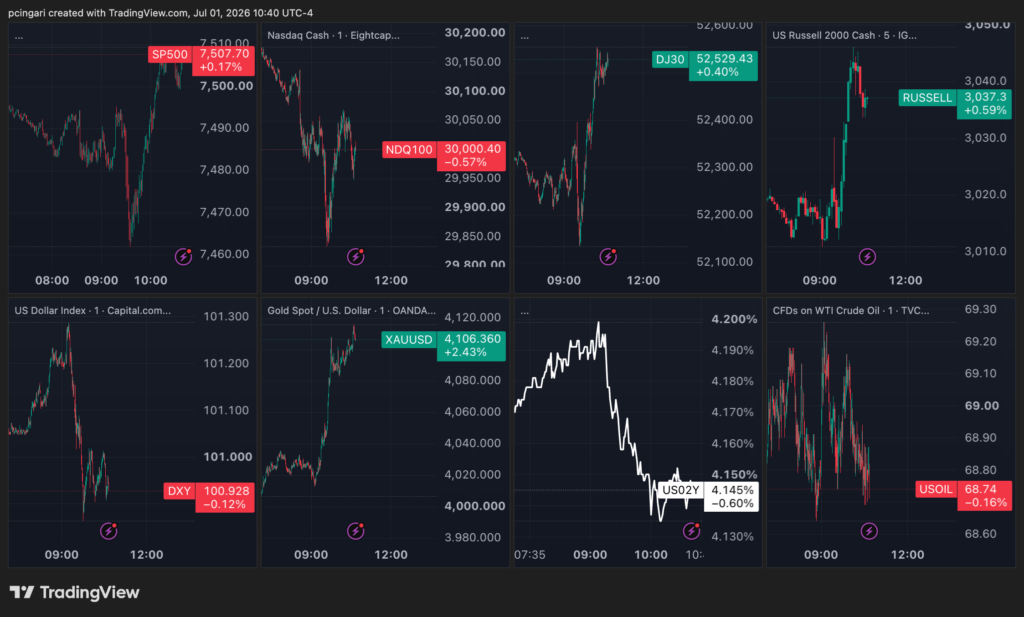
Photo: Rawpixel.com via Shutterstock.com
Login to comment