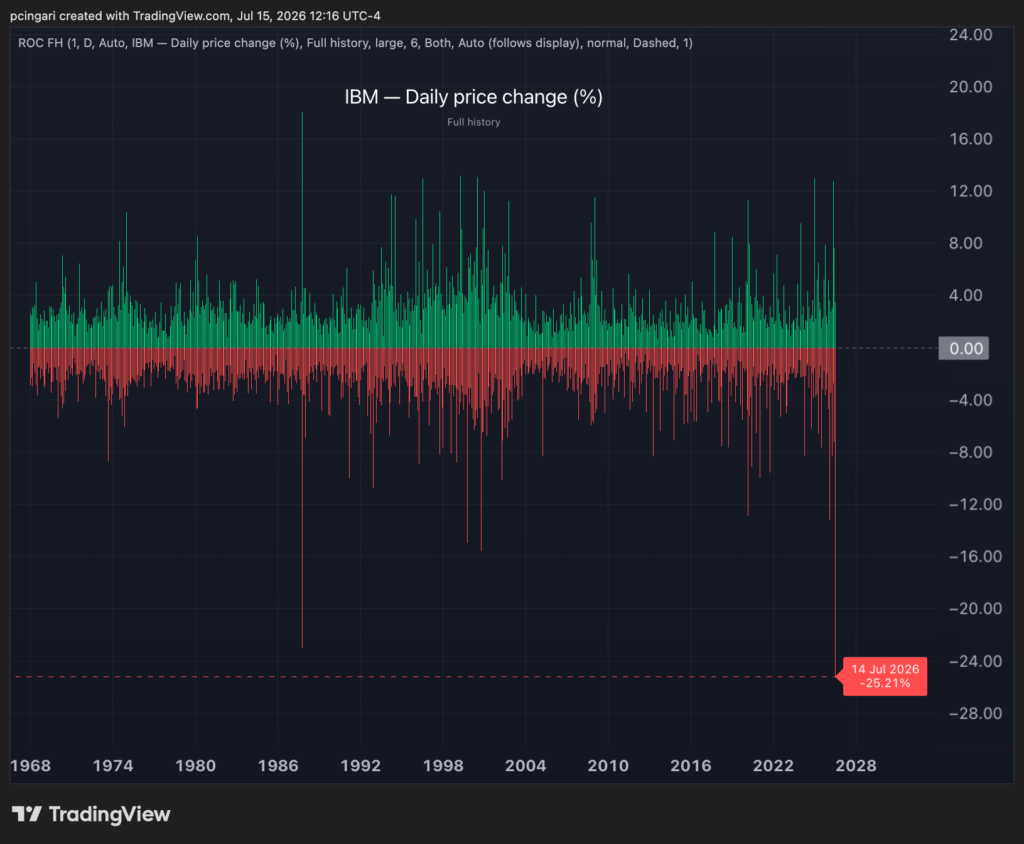
International Business Machines Corp. (NYSE:IBM) plunged 25.21% on Tuesday, recording the stock’s worst day on record, and a top investment bank just trimmed its 12-month price objective on the stock.
What Happened: Why IBM Stock Plunged
IBM pre-announced preliminary second-quarter results eight days ahead of its scheduled report date, a disclosure the company was under no obligation to make early.
Preliminary revenue came in at $17.2 billion against a Street estimate near $17.9 billion. Preliminary earnings landed at $2.93 per share versus consensus of $3.02.
The stock opened down 22% and closed at $217.07, a 25.21% single-session loss that surpassed the 22.96% decline of October 19, 1987 — Black Monday — for the worst day in IBM’s recorded history.
IBM attributed the shortfall to a reprioritization of client capital spending towards memory late in the quarter, alongside execution issues, large deal slippage and cybersecurity concerns at customers.
Bofa Cuts IBM Price Objective
On Tuesday, BofA Securities analyst Wamsi Mohan trimmed his price objective on IBM to $280 from $330 while reiterating a Buy rating.
Mohan said he was “surprised by the magnitude of the topline miss” from IBM.
The firm cut 2026 IBM’s revenue to $69.6 billion from $71.4 billion and 2026 earnings to $12.02 per share from $12.47. The 2027 estimate fell to $12.48 from $13.02.
Mohan expects IBM to lower its full-year outlook, with Software now tracking mid-single-digit growth including acquisitions rather than the double-digit trajectory management had guided toward, and Infrastructure tracking a mid-single-digit decline.
Still, the new price objective implies a 29% upside from Tuesday’s close.
Benzinga Analyst Ratings: The Street Splits
BofA was not the only firm to move on Tuesday, and the Street did not move in one direction.
HSBC downgraded IBM to Reduce from Hold and cut its price target to $191 from $231 — now the lowest target on the Street and roughly 11% below where the stock currently trades.
Oppenheimer reiterated an Outperform rating and raised its price target to $350 from $320.
Morgan Stanley maintained Equal-Weight and lifted its target to $293 from $267.
Susquehanna had recently initiated coverage on July 10 with a Neutral rating and a $303 target.
The consensus rating on IBM stands at Outperform with a consensus price target of $300.47. The range now spans $191 to $375 — a 96% gap between the most bearish and most bullish targets on a mega-cap stock.
Historical Episodes Of IBM’S Double-Digit Daily Drops
Since 1968, IBM has fallen at least 10% in a single session eight times, including Tuesday.
The forward record reads better than the headline suggests and worse than it looks.
One month out, IBM averaged a 6.75% gain with a 71.43% win rate and a median of 11.18%. Three months out, the average was 9.26% with the same hit rate and a 12.24% median. Both beat IBM’s unconditional baseline over the same windows by a wide margin — 0.69% and 2.01% respectively.
Then the edge disappears.
Six months out, the average return falls to 1.71% against an unconditional 3.92%.
Twelve months out, the average is 7.15% — below the 8.13% IBM delivered over any random year.
The win rate climbs to 83.33% at twelve months, but the median falls to 4.08%. Investors won more often and made less.
The strongest single observation is March 12, 2020, the only date positive across all four horizons with double-digit gains at each: 17.84%, 18.58%, 18.75% and 24.12%.
That was the Covid-19 event with a policy backstop arriving days later. It is the least applicable case in the set.
The failures are more instructive.
After April 8, 2002, IBM lost 18.43% over three months and 34.73% over six. After December 15, 1992, it lost 14.03% in a month and 11.14% over six. Both were company-specific breaks in a business model investors had assumed was structurally protected.
Login to comment