Just a month ago, memory was Wall Street’s favorite AI trade. Today, it has become one of the market’s biggest casualties.
Shares of SanDisk Corp. (NASDAQ:SNDK) fell over 11% on Tuesday morning. Micron Technology Inc. (NASDAQ:MU) dropped over 8%, Western Digital Corp. (NASDAQ:WDC) lost another 12%, while Seagate Technology Holdings plc (NASDAQ:STX) also sank nearly 10%. ADR shares of SK Hynix Inc. (NASDAQ:SKHY) were down 7.7%.
Since their late-June highs, SanDisk has tumbled over 50%, SK Hynix has dropped about 47%, Micron and Western Digital are each down more than 32%, and Seagate has lost about 30%.
What is really happening to what just days ago was the AI’s hottest corner of the market?
Chart: Memory Trade Is Collapsing
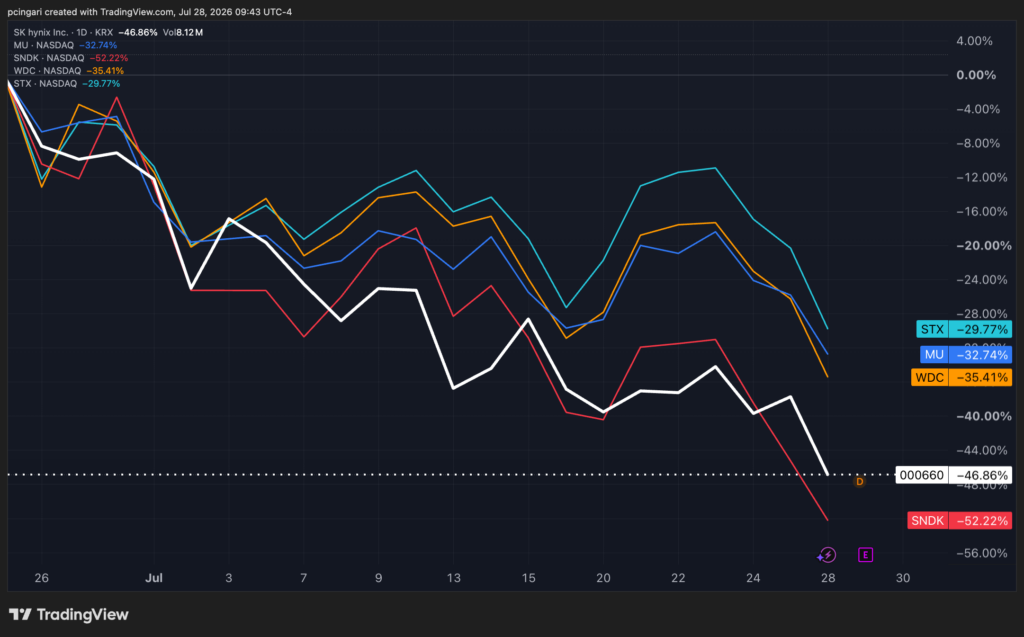
China Triggered A ‘DeepSeek Moment’ In The Memory Trade
China’s memory champion, ChangXin Memory Technologies (CXMT), stunned investors with a 466% first-day gain following its Shanghai IPO, reigniting fears that Beijing is rapidly closing the technology gap in memory chips.
Meanwhile, Chinese manufacturers have begun mass-producing domestic DUV lithography systems, fueling concerns that future supply could expand much faster than previously expected.
Yet the market’s reaction appears to assume that every memory company faces the same threat.
Nic Puckrin, cross-asset analyst and founder of Coin Bureau, says the sector is facing a “DeepSeek moment.”
“Chip makers are experiencing their DeepSeek moment after China’s semiconductor industry delivered a double blow,” Puckrin added.
Investors are reacting not only to CXMT’s blockbuster IPO but also to China’s progress in domestic lithography, he explained. The fear is that state-backed supply could eventually pressure pricing across the industry.
Nvidia’s massive financing commitments for AI infrastructure are also a concern. What began as profit-taking has evolved into a much broader reassessment of the AI semiconductor trade.
According to Puckrin, SK Hynix’s earnings may matter less than market psychology. Even record results could struggle to reverse investor sentiment if expectations remain excessively high.
Is The Market Looking At Right Side of The Trade?
Counterpoint Research analyst MS Hwang told Benzinga that China’s progress is primarily concentrated in commodity memory rather than the high-bandwidth memory (HBM) chips powering Nvidia’s AI accelerators.
“Chinese vendors are catching up quickly in commodity DRAM and NAND. Yet, the HBM is difficult to catch up.”
Hwang added that Chinese suppliers may not manufacture HBM3 until the first half of 2027, when Micron, SK Hynix and Samsung are expected to have already moved into HBM4 production.
That distinction matters because HBM has become the semiconductor industry’s most valuable niche.
Just days ago, reports indicated Nvidia has secured multi-year HBM supply agreements worth as much as $500 billion with SK Hynix, while separate industry reports suggest Nvidia, SK Hynix, Samsung and Broadcom have collectively locked in nearly $950 billion of long-term HBM supply commitments.
Those agreements point to customers securing capacity years in advance rather than preparing for a collapse in demand.
Why One Investor Isn’t Worried About China’s Memory Chip Rise
Yuri Khodjamirian, chief investment officer at Tema ETFs, sees China’s rise differently from the market.
Ironically, Tema made CXMT the largest holding in its memory ETF on the day of the IPO, yet it did not reduce its exposure to Micron.
“The industry fundamentals are very strong now,” Khodjamirian told Benzinga.
“This is an undersupplied market well into 2028.”
According to Khodjamirian, investors are confusing China’s advance in commodity memory with leadership in AI memory.
“It took a long time for Micron’s HBM to be certified. It’s not easy to do this,” he said.
He also dismissed the idea that Chinese HBM will soon replace Micron or SK Hynix inside Nvidia-powered AI servers.
“I don’t think U.S. AI builders are going to be using HBM from China,” Khodjamirian said.
His broader argument is that Wall Street continues to value memory stocks as if this were another boom-and-bust commodity cycle.
“We think the market is underestimating how much these companies are signing long-term agreements with their customers and how transformed the industry has become,” he said.
… So What Gives?
That leaves investors with a critical question.
Has Wall Street correctly identified the beginning of a new competitive threat that will erode the AI memory boom?
Or is the market treating every memory company as a commodity producer, even as long-term AI supply agreements and HBM technology continue to create a widening gap between commodity DRAM and the most advanced memory powering the world’s largest AI systems?
The answer may determine whether this month’s biggest losers become the next opportunity in the AI trade.
Image: Shutterstock
Login to comment