U.S. Semiconductors Following South Korea
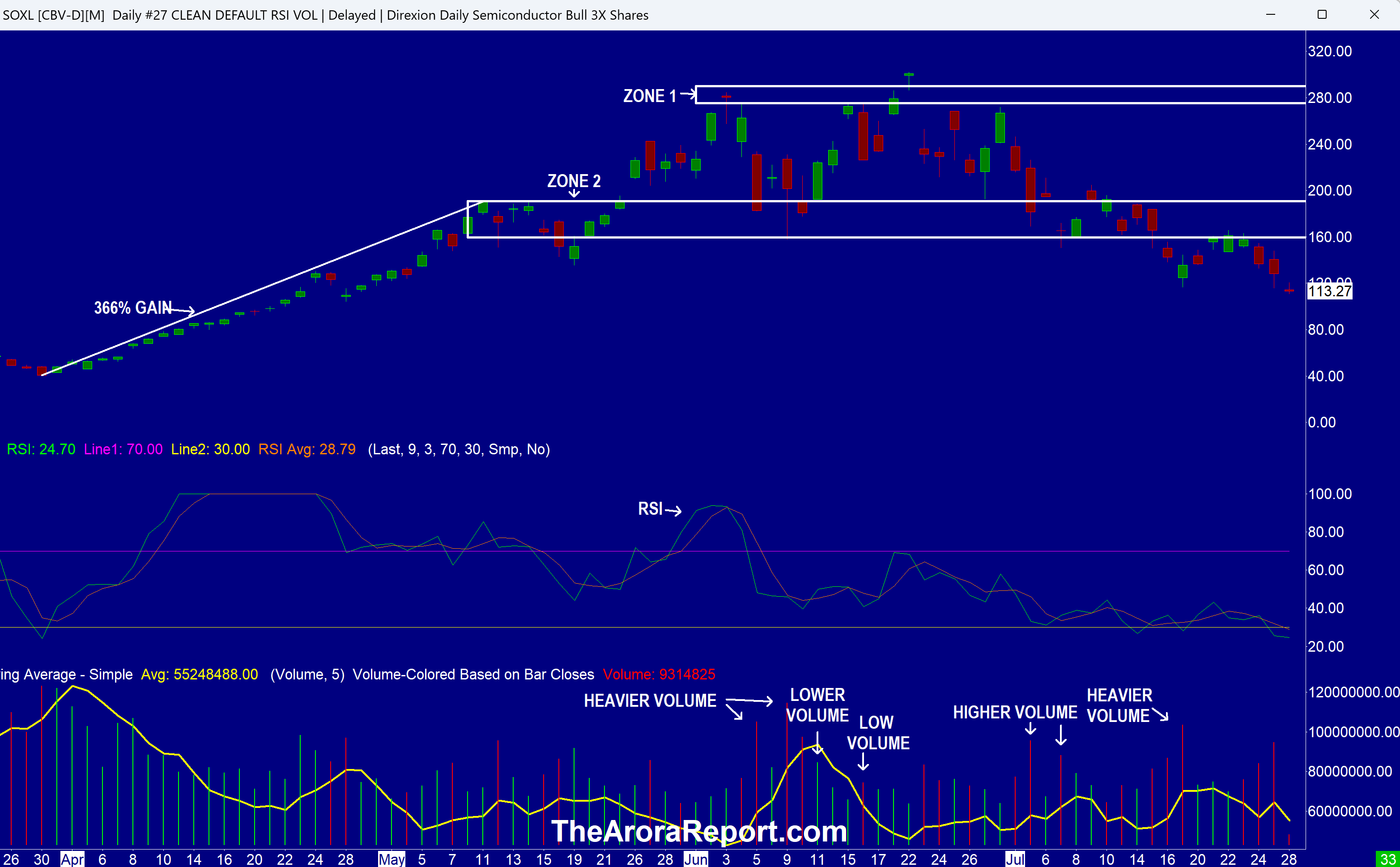
Please click here for an enlarged chart of Direxion Daily Semiconductor Bull 3X ETF (NYSE:SOXL).
Note the following:
- Semiconductors are the leading sector that drove the stock market higher. SOXL is the momo crowd’s favorite semiconductor ETF.
- The chart shows that SOXL is now making lower lows in the early trade. This is a negative.
- The chart shows that the rally from the July 17 low failed at the low band of zone 2 (resistance). This is a negative.
- RSI on the chart shows that semiconductors are very oversold. Oversold conditions often lead to a bounce.
- We have been sharing with you that lately semiconductors in the U.S. have been following the South Korean market. Today is no different. Overnight, South Korea’s Kospi index was down 10%. Semiconductors in the U.S. are falling in the early trade, as shown on the chart. Investors need to remember that until recently, the South Korean stock market followed the U.S. stock market.
- We have been sharing with you for a while that competition was going to come from China in memory and the stock market was oblivious. Overnight, the South Korean stock market fell because the market woke up to there being competition from China after being oblivious for a long time.
- Yesterday we shared with you that Chinese memory maker CXMT rose 466% on its first day after IPO. The success of the CXMT IPO has turned out to be the trigger to wake up the market to the threat of competition from China.
- We have long shared with you that an essential technology for the production of modern sophisticated AI chips is extreme ultraviolet lithography. We have been sharing with you that a Dutch company ASML Holding NV (NASDAQ:ASML) holds a near monopoly, but Chinese companies were attempting to produce their own machines.
- Now, the stock market is waking up to the fact that China will produce its own machines. In our analysis, at least for today, the stock market is over estimating the China threat on extreme ultraviolet lithography in the near term. In our analysis, in the near term, Chinese machines are not likely to be sophisticated enough to produce high end chips.
- The stock market is doing what it often does – stay oblivious to a new development for a long time and then all of a sudden wakes up and overreact. The reason for this phenomenon is the dominance of the momo crowd driven by momo gurus. The momo crowd does not do any deep analysis and is simply driven by greed and fear. Momo gurus’ real job is to run up the stocks in the guise of analysis, so they never share any negative news even when they are aware of it.
- After the momo crowd, the technical analysis crowd is the most dominant in the stock market. The fact is many fundamental analysts are closet chartists. The technical analysis crowd does not understand that traditional technical analysis no longer works well. Please click here to see the reasons.
- Also adding to concern is circular financing in AI. We have been warning about circular financing for a couple of years and sharing similarities to vendor financing before the 2000 crash.
- To be successful in the next phase of AI, investors need to change how they think about AI. Knowing how to think correctly will help investors extract more out of the markets.
- If semiconductors do not bounce after the regular session open, expect momo accounts to be hit with margin calls and forced liquidations.
- The FOMC meeting starts today and a rate decision will be announced tomorrow at 2pm ET.
- Not long ago, the consensus was the Fed would leave interest rates unchanged, but the macro picture has changed. In our analysis, if the Fed were to make a cold, hard decision based solely on data, the Fed should raise interest rates. On the flip side, the Fed is under intense pressure from President Trump to cut interest rates. Investors should consider this Fed meeting live and know that there is a fair probability of a surprise tomorrow.
- On the positive side for the stock market, Oman is proposing joint control of the Strait of Hormuz with Iran. Under this proposal, paying a fee to pass through the Strait of Hormuz will be voluntary. In our analysis, this is a major breakthrough and has the potential of resolving the Iran war. The reason is that making the fee voluntary would allow President Trump to declare victory and say he made sure there are no fees to pass through the Strait of Hormuz. It would also allow Iran to declare victory by saying they won on their main issue of imposing fees for passage through the Strait of Hormuz.
Magnificent Seven Money Flows
Most portfolios are now heavily concentrated in the Mag 7 stocks. For this reason, it is important to pay attention to early money flows in the Mag 7 stocks on a daily basis.
In the early trade, money flows are positive in Apple Inc (NASDAQ:AAPL), Amazon.com, Inc. (NASDAQ:AMZN), Alphabet Inc Class C (NASDAQ:GOOG), Meta Platforms Inc (NASDAQ:META), Microsoft Corp (NASDAQ:MSFT),, and.
In the early trade, money flows are negative in NVIDIA Corp (NASDAQ:NVDA) and Tesla Inc (NASDAQ:TSLA).
In the early trade, money flows are mixed in SPDR S&P 500 ETF Trust (NYSE:SPY) and Invesco QQQ Trust Series 1 (NASDAQ:QQQ).
Momo Crowd And Smart Money In Stocks
Investors can gain an edge by knowing money flows in SPY and QQQ. Investors can get a bigger edge by knowing when smart money is buying stocks, gold, and oil. The most popular ETF for gold is SPDR Gold Trust (GLD). The most popular ETF for silver is iShares Silver Trust (SLV). The most popular ETF for oil is United States Oil ETF (NYSE:USO).
Bitcoin
Bitcoin (CRYPTO:BTC) is seeing selling.
What To Do Now
Consider continuing to hold good, very long term, existing positions and add tactical positions based on signals.
The Arora Report is known for its accurate calls. The Arora Report correctly called the big artificial intelligence rally before anyone else, the new bull market of 2023, the bear market of 2022, new stock market highs right after the virus low in 2020, the virus drop in 2020, the DJIA rally to 30,000 when it was trading at 16,000, the start of a mega bull market in 2009, and the financial crash of 2008. Please click here to sign up for a free forever Generate Wealth Newsletter.
Benzinga Disclaimer: This article is from an unpaid external contributor. It does not represent Benzinga’s reporting and has not been edited for content or accuracy.
Login to comment