U.S.-listed South Korea ETFs are under pressure after the country’s stock market extended its sharp selloff, highlighting how investors in these funds are increasingly exposed to the fortunes of the artificial intelligence trade rather than the broader Korean economy.
The benchmark Kospi Index plunged as much as 9.8% on Wednesday, triggering a market-wide circuit breaker for a second straight session. The index briefly fell below the 6,000 mark, its lowest level since early April, and is now on track for a record monthly decline of about 35%. From its peak a month ago, the Kospi has lost roughly 40%, reversing a world-beating rally led by memory chip giants SK Hynix Inc (NASDAQ:SKHY) and Samsung Electronics.
Three ETFs, Three Ways to Play South Korea
The iShares MSCI South Korea ETF (NYSE:EWY) remains the dominant U.S.-listed vehicle for Korean equities, managing more than $23 billion in assets. The fund tracks the MSCI Korea 25/50 Index, holds 78 stocks, charges a 0.59% expense ratio, and trades at a price-to-earnings ratio of 21.2x. It has returned 48% year-to-date through Wednesday, thanks to the country’s AI-driven rally. The fund dipped 6.1% on Tuesday and was down 3.1% Wednesday pre-market.
Despite this, EWY is far from diversified in practice. Roughly half of its portfolio is concentrated in Samsung Electronics and SK Hynix, meaning the fortunes of two semiconductor companies largely determine the ETF’s performance.
For investors seeking a lower-cost alternative, the Franklin FTSE South Korea ETF (NYSE:FLKR) charges just 0.09%, a far cry from EWY’s 0.59%. FLKR tracks the FTSE South Korea Capped Index and owns a broader basket of Korean equities, including more mid-cap companies, giving it slightly greater diversification. However, Samsung and SK Hynix still dominate returns because of their market capitalizations, leaving FLKR similarly exposed to swings in AI-related sentiment. The fund fell 5.2% on Tuesday and was down almost 4% in pre-market trading, Wednesday.
Meanwhile, the Direxion Daily MSCI South Korea Bull 3X Shares (NYSE:KORU) offers a much more aggressive approach, seeking three times the daily performance of South Korean equities. Designed for tactical traders rather than long-term investors, the ETF resets leverage daily, making consecutive declines like this week’s particularly painful as losses compound. This fund saw an 18% erosion of its price on Tuesday.
KORU Magnifies the AI Trade—and the Pain
Among U.S.-listed South Korea ETFs, KORU has emerged as the highest-risk way to bet on the country’s AI-driven equity market. The Direxion fund seeks to deliver 300% of the daily performance of the MSCI Korea Index, making it a tactical trading vehicle rather than a long-term investment.
That leverage has amplified the recent selloff. KORU fell nearly 18% in one session before sliding almost 20% overnight, and is now headed for its worst monthly decline on record, down nearly 64% in July. Even so, the ETF remains up about 35% for 2026, underscoring the extreme volatility that has accompanied South Korea’s AI boom and bust.
The losses have coincided with a broad technology selloff that has hit semiconductor stocks globally.
KORU’s sharp swings reflect the concentration of the MSCI Korea Index itself. SK Hynix and Samsung Electronics together account for more than half of the benchmark, meaning weakness in the two chipmakers can quickly translate into outsized moves for leveraged investors.
The pain has been especially acute for retail investors, who helped fuel South Korea’s AI rally through margin loans and leveraged ETFs. Finance Minister Koo Yun-cheol apologized this week after recent rule changes sparked a surge in speculative trading, according to CNBC. Since the launch of single-stock leveraged ETFs in late May, Korean retail investors have bought about 14 trillion won of the products (listed in the South Korea stock market), compared with roughly 2 trillion won by foreign investors, according to KB Financial Group. Many of those bets have unraveled.
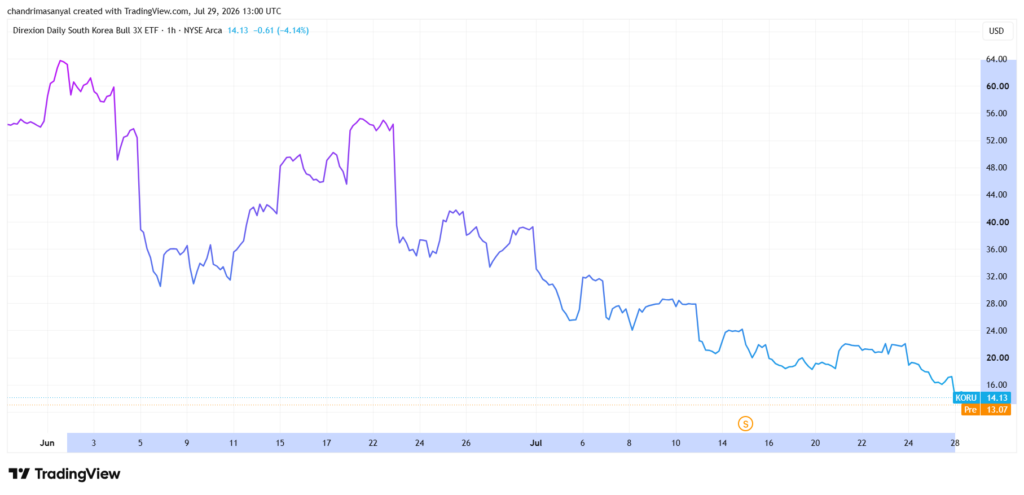
Leverage Is Amplifying the Downturn
Retail investors, who helped fuel this year’s rally through margin loans and leveraged ETFs, sold about 1.7 trillion won ($1.2 billion) of Korean equities on Wednesday as forced liquidations accelerated.
“There have been a lot of forced liquidations today,” said Jung In Yun, CEO of Fibonacci Asset Management Global, according to Bloomberg. “We need to wait out until selling from retail investors ease.”
The Kosdaq Index also fell more than 8%, triggering its own 20-minute trading halt. Remarkably, nine of the Kospi’s 15 circuit breakers since 2000 have occurred this year.
With Samsung Electronics set to report earnings next, investors in EWY, FLKR and KORU will be watching closely. The recent correction has compressed valuations, but with South Korea’s equity benchmarks still heavily concentrated in AI chipmakers, the outlook for these ETFs remains closely tied to whether the next phase of AI spending can live up to the market’s lofty expectations.
Photo: Kittyfly / Shutterstock
Login to comment