South Korea’s stock market just delivered the largest single-day gain in its 46-year history, rising 17.9% on Friday.
The only other session in which the index gained more than 10% was Oct. 30, 2008.
SK Hynix Inc. (NASDAQ:SKHY) rose 29.95% in Seoul to 1,718,000 won, touching the 30% daily price limit the Korea Exchange has imposed on individual stocks since June 2015, marking the strongest day on record.
Samsung Electronics Co., Ltd. (OTC:SSNLF) gained 26.81%, again the company’s largest one-day advance on record.
Both moves were reactions to a hole, not a breakout.
Measured from its June 19 record of 9,385.59, the KOSPI’s drawdown reached nearly 44% earlier this week, deeper than the 31% it lost during the March 2020 pandemic selloff.
SK Hynix fell roughly 58% from its June 25 intraday peak before Friday. Even after the rebound, the KOSPI index finished July down more than 20%.
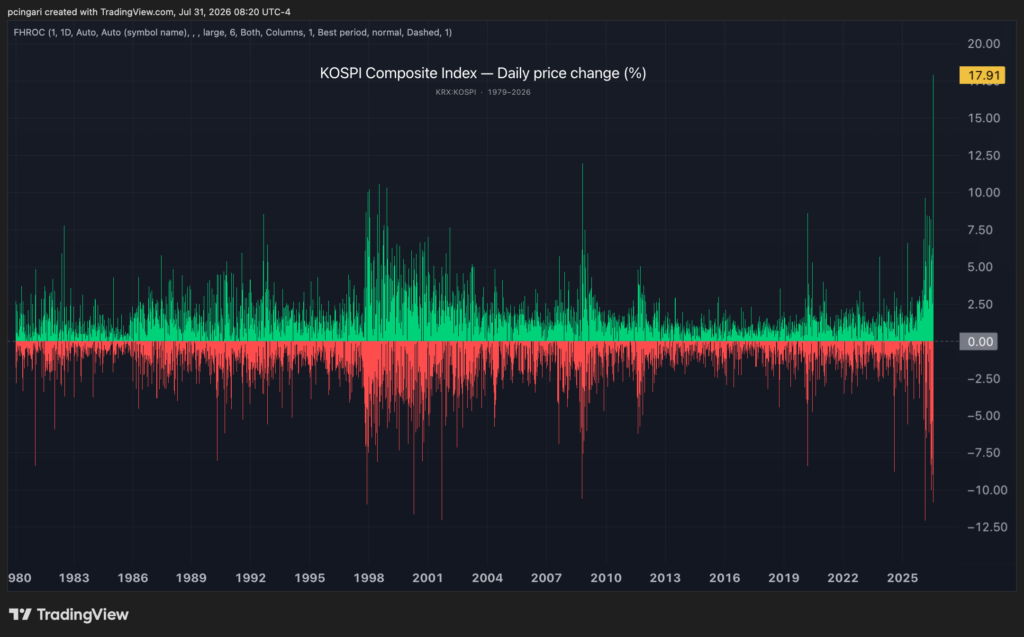
24 Hours Earlier South Korea Was In A Freefall
The Kospi peaked at 9,385.59 on June 19 after roughly doubling in six months. It bottomed at 5,262.77 in late July.
That is a 43.9% drawdown. The March 2020 pandemic crash took 31.1%.
Korean retail investors had financed the first half of that rally with margin debt and single-stock leveraged ETFs, a product the exchange introduced only in May 2026. Once prices turned, those positions liquidated on their own.
Circuit breakers halted trading on July 28 and July 29, the first back-to-back halts in the exchange’s history.
Two headlines out of China supplied the spark. Chinese memory maker CXMT raised $8.6 billion in a Shanghai listing and rose 466% on debut.
A day later, reports said China had begun mass-producing domestic deep ultraviolet lithography tools, the equipment Western export controls were designed to withhold.
What Actually Turned It
The catalyst was American.
Microsoft Corp. (NASDAQ:MSFT) reported fiscal fourth-quarter revenue of $90.01 billion against $87.62 billion expected, with Azure growth accelerating to 43% from 40% in the prior quarter.
Analysts had modeled 40%. Shares rose about 15% on Thursday.
Amazon.com Inc. (NASDAQ:AMZN) followed Thursday with an AWS reacceleration that pushed the stock up more than 9% in extended trading.
Two of the largest buyers of high-bandwidth memory told the market their cloud demand was still outrunning supply. Korean memory is the bottleneck moving one step downstream.
The Philadelphia Semiconductor Index – as tracked by the iShares Semiconductor ETF (NYSE:SOXX) – closed up 8.2% on July 30.
Seoul opened the next morning and triggered a buy-side sidecar. Foreign investors bought a net 7.25 trillion won ($5.06 billion) of Kospi shares Friday.
They had sold 18.5 trillion won during July and nearly 51 trillion won in June.
“Semiconductor shares were the main driver of the Kospi’s surge,” said Kim Seok-hwan, an analyst at Mirae Asset Securities.
JPMorgan wrote in a Korea strategy report Friday that “the positioning setup in Korea now appears attractive on balance,” adding that the leveraged ETF unwind is complete and hedge funds have finished roughly 90% of their de-leveraging.
Samsung posted record operating profit of 89.5 trillion won on record revenue of 171.5 trillion won. SK Hynix delivered 60.54 trillion won in operating profit at a 76% operating margin, its cumulative first-half revenue crossing 100 trillion won for the first time.
SK Group Chairman Chey Tae-won bought 3,620 SK Hynix shares on Thursday for about 4.8 billion won, his first direct purchase of the stock. It gained more than 20% in value within a day.
For U.S. investors, the iShares MSCI South Korea ETF (NYSE:EWY) closed Thursday at $161.21, still about 27% below its 52-week high of $220.88.
Photo: Kittyfly / Shutterstock
Login to comment