Editor’s Note: This article has been updated to reflect the revised June Producer Price Index figure and to include additional content.
The Producer Price Index (PPI) was unchanged in July, coming in below the 0.2% monthly rebound economists expected after June’s upwardly revised 0.1% decline, the Bureau of Labor Statistics reported Thursday.
The annual producer inflation rate eased to 4.7%, down from 5.5%, and below the 4.9% consensus.
Core PPI, which strips out food and energy, rose 0.2% in the month against the 0.3% expected, with the annual core rate easing from 4.7% to 4.2%, in line with expectations.
The print lands a day after the July Consumer Price Index (CPI) rose just 0.1% month over month, pulling annual inflation down to 3.4% from 3.5%, with core CPI up 0.2% and its annual rate easing to 2.5%, an in-line report that showed the energy-driven inflation burst continuing to fade.
Where Did Producer Prices Fall And Rise In July?
Energy was the biggest source of relief.
Final-demand energy prices fell 3.1% in July after declining 2.8% in June. Gasoline prices dropped 5.7%, accounting for more than half of the decline in final-demand goods prices.
Food prices also fell, with final-demand food prices down 0.9%. Diesel fuel, jet fuel and residual fuel prices declined as well.
Not everything moved lower.
Prices for motor vehicles and equipment rose 0.3%, while electric power and grains also increased. On the services side, final-demand prices rose 0.2%, which was considerably slower than the 0.5% increase in June.
One notable exception was portfolio management, where prices jumped 6.5% in July.
Overall, final-demand goods prices fell 0.7%, while services rose only 0.2%. The result was a flat headline PPI reading for the month.
There was also an important divergence beneath the flat headline.
Prices for final demand less foods, energy and trade services — the gauge the Fed watches most closely for the inflation trend — rose 0.4% in July, compared with just 0.1% in June.
That suggests the disinflation story is not completely uniform.
Market Reactions
The market initially treated the report as another piece of good news for the Fed.
The 2-year Treasury yield fell to 4.163%, while the dollar slipped and gold moved higher.
U.S. equity futures also edged up, with the S&P 500, Nasdaq 100, Dow Jones and Russell 2000 all in positive territory.
On Wednesday, the SPDR S&P 500 ETF Trust (NYSE:SPY) closed at $772.49, just 0.3% below record highs.
The key number, however, remains the September Fed meeting.
Fed futures still imply a 38.4% probability of a 25-basis-point hike, against a 61.6% probability of no change.
That probability has fallen from 55% one week ago and 51.2% one month ago for a hike, according to the market data in the chart.
In other words, the market is already moving toward a Fed hold.
Today’s PPI report gives that move another reason to continue.
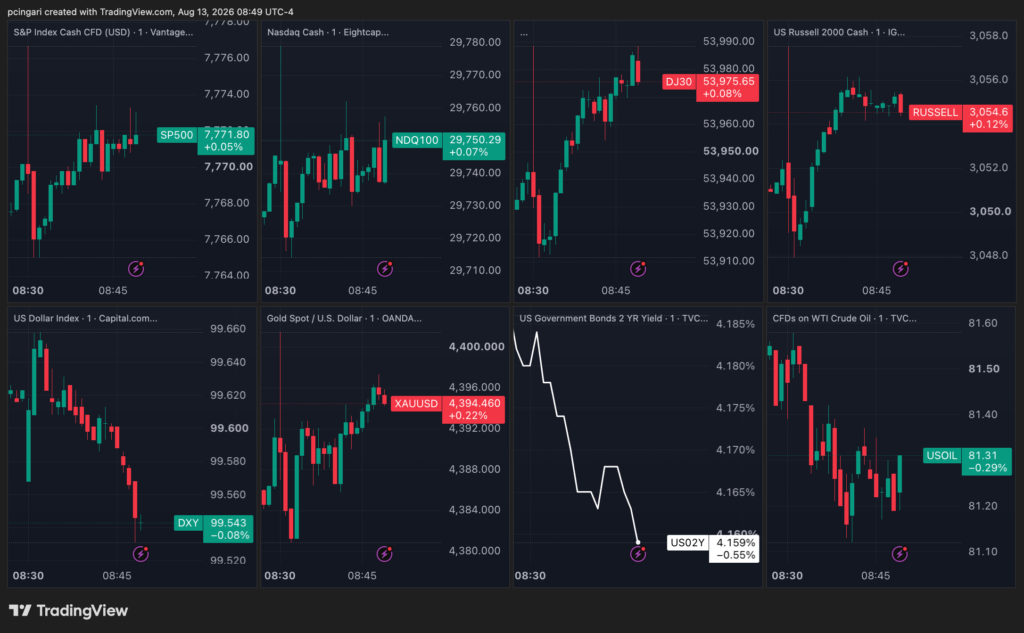
Image created using artificial intelligence via Midjourney.
Login to comment