Oil dropped to a one-week low Tuesday after Washington unveiling its most sweeping sanctions campaign against Iran on record.
West Texas Intermediate traded near $82.35 a barrel by 7:38 a.m. ET, down 3.2% below Monday’s settlement around $84.89. Brent crude for October fell 2.92% to $89.48.
The market it is pricing the odds that the war restarts, and every headline since Monday afternoon has pushed those odds lower.
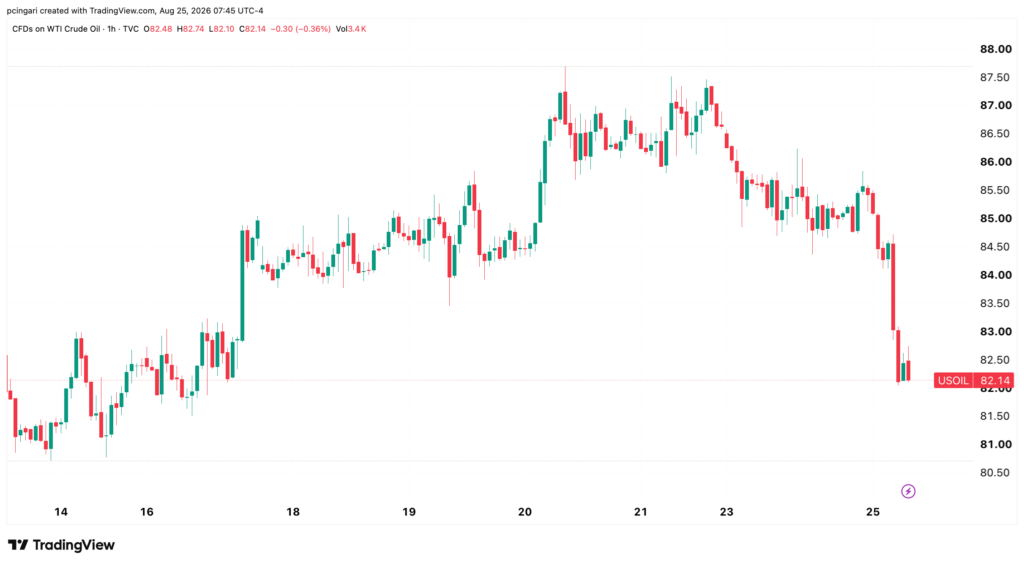
Chart: WTI crude, hourly. Source: TradingView
The Headline That Actually Moved Crude
Two reports landed overnight.
The New York Times, citing an internal State Department document, reported that Washington is preparing to send Foreign Service officers back to Middle East embassies evacuated during the war, with returns possible as early as this week across eight host countries including Kuwait, Iraq, Qatar and Israel.
Then Al Arabiya reported that Pakistan Army Chief Asim Munir had carried a U.S. proposal to Tehran offering to halt the naval blockade and lift sanctions in exchange for reopening the Strait of Hormuz and ending attacks by Iran-aligned groups.
Iranian officials said they would respond after domestic consultations.
Neither headline promises a deal.
Both tell traders the same thing: nobody in Washington is preparing for the next strike.
Why The Sanctions Package Was Read As Dovish
Monday’s announcement set the tone.
Treasury Secretary Scott Bessent unveiled the package Monday, calling it an economic D-Day and sanctioning about 60 entities, individuals and vessels across shipping, gold, aviation, technology and digital assets.
But the enforcement was deferred.
What Bessent did not do was name which of Iran’s trading partners face secondary penalties, or say when.
Asked why, he said: “Why would I want to blow up the global financial system?”
Saxo Bank commodity strategy head Ole Hansen said the pivot from military escalation to economic pressure has drained some of the market’s supply anxiety, noting the package landed softer than traders had feared.
“Traders increasingly focused on signs that the immediate risk of another major escalation in the U.S.-Iran conflict may be receding,” he said on Tuesday.
What Cheaper Crude Does To Everything Else
Falling oil pulled Treasury yields down with it. The 10-year Treasury yield slipped to 4.662% from 4.704%.
Lower energy costs feed straight into lower expected inflation, which loosens the constraint on the Federal Reserve.
Equities took the handoff.
SPDR S&P 500 ETF Trust (NYSE:SPY) rose 0.48% in premarket trading. Industrial Select Sector SPDR Fund (NYSE:XLI) gained 0.92% and Delta Air Lines Inc. (NYSE:DAL) climbed 2.12%
Energy went the other way.
United States Oil Fund LP (NYSE:USO) fell 3.57% premarket, Energy Select Sector SPDR Fund (NYSE:XLE) dropped 1.00% and Occidental Petroleum Corp. (NYSE:OXY) lost 1.75%.
Login to comment