When President Donald Trump won the November 2024 election, he was explicit about the purpose of his second term.
The United States had bought $1.22 trillion more in goods from the rest of the world than it sold in 2024, and that gap had to close. Tariffs were the instrument.
Nineteen months in, the gap has not closed. And the fastest-growing piece of it is the one category Washington has gone out of its way not to tax.
The AI buildout is doing the importing.
July Trade Deficit Widens To March 2025 Highs
The U.S. goods trade deficit widened to $118.8 billion in July from $101.4 billion in June, according to the Census Bureau advance report published Thursday.
That is the widest monthly goods gap since March 2025, when importers rushing shipments ahead of the first tariff rounds pushed it to a record $158.7 billion.
Imports rose 3.7% to $318.2 billion, the highest in 16 months. Exports fell 2.9% to $199.4 billion, a third straight monthly decline and the lowest level since January.
Almost the entire increase sat in one line.
Capital goods imports, the category that covers computers, computer accessories and semiconductors, jumped 11.3% to $140.1 billion. Every other import category combined fell 1.6%.
Capital goods now make up 44% of everything the United States buys abroad. That line was $92.0 billion in August 2025. It is 52% higher today.
For scale on how little the tariffs have shifted the underlying arithmetic: the goods deficit averaged $101.3 billion a month across 2024, and in June of this year it ran at $101.4 billion.
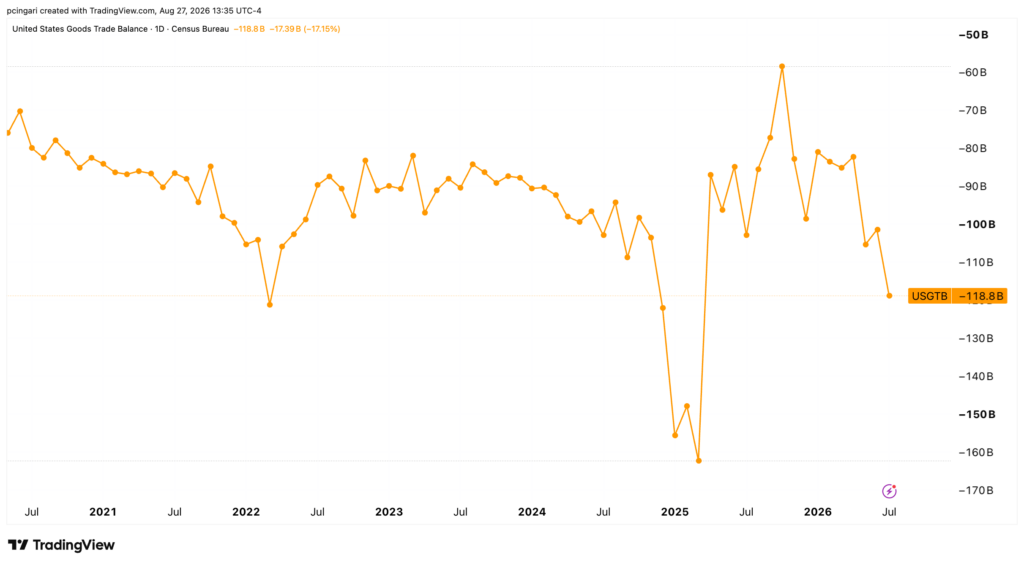
Trump’s Tariff Math Meets A Different Kind Of Import
Oxford Economics said the July data showed "relentless business spending on high-tech goods associated with the AI buildout."
The firm’s analysis expects capital-goods imports to remain strong into 2027.
It also estimates that net trade could subtract about 1 percentage point from third-quarter GDP growth, with risks tilted toward an even larger drag.
“While a weaker dollar may support exports in the months ahead by making U.S. goods relatively cheaper, we don’t expect that impulse to exports to offset the drag from imports,” Matthew Martin, senior U.S. Economist, said.
“Ongoing demand for AI hardware will keep capital goods strong for the foreseeable future,” he added.
South Korea Is Where The AI Trade Deficit Gets Interesting
There is a country hiding inside that capital-goods surge.
South Korea.
In July, Korean exports to the United States rose 68.7% from a year earlier to $17.43 billion. Total Korean exports hit $98.89 billion, the second-highest month on record and the fourteenth consecutive month to set an all-time high for its calendar month.
Semiconductor exports alone were $41.01 billion, up 178.8%, above $40 billion for a second straight month.
This is not a coincidence. America is building AI data centers. South Korea is supplying some of the most critical components inside them: Memory.
Artificial intelligence systems need enormous amounts of high-bandwidth memory, or HBM, to move data quickly between processors and memory.
Samsung Electronics Co. Ltd. (OTC:SSNLF), SK Hynix Inc. (NASDAQ:SKHY) and Micron Technology Inc. (NASDAQ:MU) control more than 95% of global DRAM output, and all three have shifted wafer capacity toward high-bandwidth memory, the stacked chips that sit alongside AI accelerators.
SK hynix has described its 2026 capacity as effectively sold out. Chief executive Kwak Noh-jung said in July that 2027 will be the worst year in the industry’s history on the supply side.
Photo: Shutterstock
Login to comment