A global bond selloff has pushed borrowing costs to multi-decade highs across major economies such as the U.S., UK and Japan, while China’s yields sit near record lows.
Yields Are at Levels Not Seen in Decades
“The yield crisis has gone global. Except for China,” The Kobeissi Letter said in a post on X on Tuesday, adding that its 10-year yield sits at 1.69%.
Meanwhile, the 10-year yield in the U.S. climbed to 5.04%, its highest since 2007.
In the UK, 30-year yields are at their highest since 1998, while France’s 10-year yield is at its highest since 2008 and Germany’s 10-year Treasury yield is at its highest since 2009.
Japan’s 10-year bond yield hit its highest since 1996.
“China’s economy is in its own world,” the market commentator added.
Why China’s Bond Yields Are Staying Low
China is still working through a multi-year deflationary stretch, with the 2021 property crash continuing to drag on consumption and price growth.
That backdrop has reinforced expectations for an accommodative monetary-policy stance from the People’s Bank of China.
China’s central bank has kept its benchmark loan prime rates unchanged at record lows for 15 straight months as of August, holding the one-year rate at 3.00% and the five-year rate at 3.50%.
Oil Fuels Rate-Hike Hike Bets
The conflict in Iran has sent oil back above $100 a barrel, adding pressure on central banks to raise rates to fight inflation, a major driver of the global rise in bond yields.
The Federal Reserve is expected to raise rates Wednesday for the first time since 2023, with the CME FedWatch tool putting the odds of a hike at 92.4%.
The European Central Bank raised rates last week.
Foreign Investors Are Favoring U.S. Stocks Over Treasuries
Economist Mohamed El-Erian pointed to a Financial Times report, citing Deutsche Bank’s analysis of Treasury data, showing foreign investors bought more U.S. stocks than government bonds through June, with international equity flows reaching 2.8% of U.S. GDP versus 2% for Treasuries.
That marks the first time this century, outside brief periods during the COVID-19 pandemic and the aftermath of the global financial crisis, that foreign flows into stocks have overtaken flows into government debt.
Price Action: The iShares 7-10 Year Treasury Bond ETF (NASDAQ:IEF) closed 0.12% lower on Tuesday at $90.82 and climbed 0.02% in early premarket trading on Wednesday. Meanwhile, the iShares 20+ Year Treasury Bond ETF (NASDAQ:TLT) fell 0.06% on Tuesday to $80.66 and is down another 0.06% in pre-market trading.
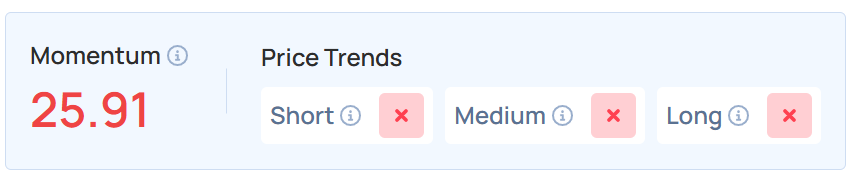
According to Benzinga edge rankings, the iShares 7-10 Year Treasury Bond ETF has a Momentum score in the 25th percentile and a negative price trend across the short, medium, and long term.
See More: Top Momentum Stocks
Disclaimer: This content was partially produced with the help of AI tools and was reviewed and published by Benzinga editors.
Photo courtesy: Shutterstock
Login to comment