Silver can be an intriguing market for option selling investors today. Because of its unique characteristics as both a monetary gauge and industrial metal, many traders are puzzled as to what really makes it move.
This can provide opportunities for those that understand the white metal. And in light of this month’s focus on the Fed, silver is a particularly relevant market in which to look for premium.
Silver As Financial Instrument
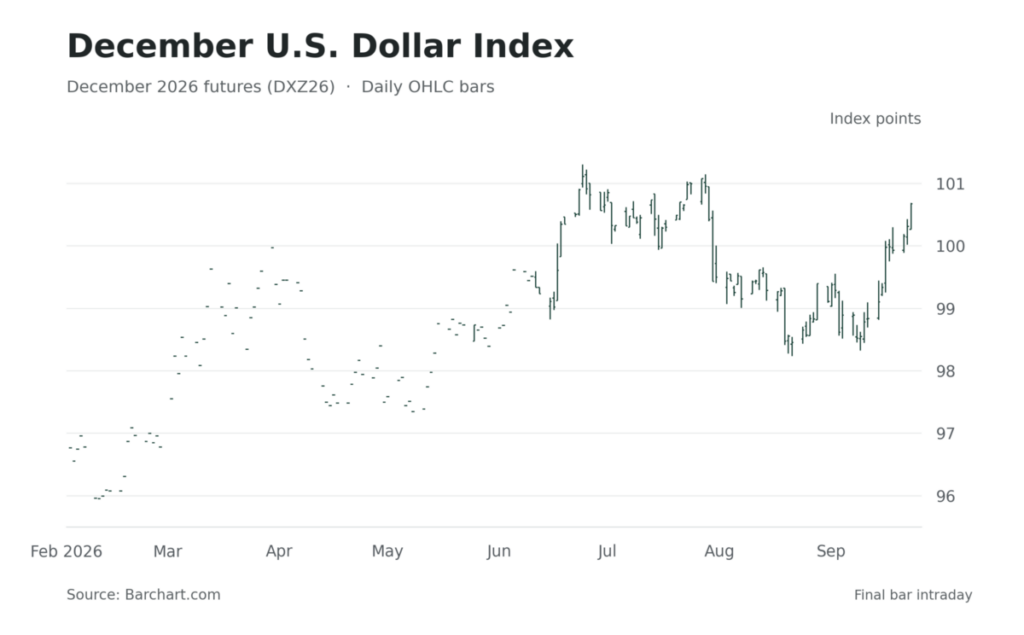
Like gold, part of silver’s value is made up from its use as an inflation hedge. That means understanding its relation to the dollar. At the risk of grossly oversimplifying, a stronger dollar is generally bearish silver. A weaker dollar is generally bullish silver.
Thus, the Fed moving to raise rates could be bearish for silver if it helps support the dollar. On September 16, the Federal Reserve raised its target range by a quarter of a percentage point to 3.75%-4.00%, citing elevated inflation.
At the risk of grossly oversimplifying, a stronger dollar is generally bearish silver. A weaker dollar is generally bullish silver.
However, if the Fed holds off on further increases, it could be less bullish for the dollar and thus less bearish for silver. We use these measured terms because we believe a Fed pause would not necessarily translate into a steep correction in the dollar. In fact, U.S. policy rates remain above the European Central Bank’s 2.50% deposit rate, even after Europe’s latest increase. If investors continue to favor those higher U.S. rates, the greenback could remain the “best of the worst” when it comes to currencies.
Despite the recent setback, the Greenback should remain the "Best of the Worst" when it comes to currencies.
While a future Fed “non-move” could be an opportunity for entry into a silver position, we would not consider it, by itself, a reason to expect a sustained rally. Much depends on what traders have already priced in.
Silver As Industrial Metal
While silver can often take on characteristics of gold in a financial role, it also borrows tendencies from its more industrial cousins. With about 58% of silver demand tied to industrial use in 2025, silver could be classified as an industrial metal. Silver is used in a variety of industries and products including solar panels, electronics, automotive systems and antibacterial applications in the health industry.
In solar manufacturing in particular, companies are finding ways to use less silver in each panel, or to replace it with other materials. The Silver Institute’s April outlook projected a roughly 3% decline in industrial silver demand in 2026, chiefly because of lower solar-sector consumption. Growth in data centers, vehicles and power grids still provides support. But more solar panels do not necessarily mean more silver demand.
Silver’s use as an industrial metal accounts for approximately 58% of demand.
Thus, the industrial demand outlook gives silver bulls something to contend with. A growing market for the products that use silver does not always translate into a growing market for silver itself.
Silver’s Less Known Tie To Other Metals
Silver, however, can also take price cues from other industrial metals. Silver is mined with (and is often found combined with) other elements such as copper, lead and zinc. Changes in the supply/demand equation for these metals can spill over into silver prices.
For instance, if demand for copper wanes while mines continue producing, silver recovered alongside it can keep coming to market as well. If producers cut output, however, silver supply can fall with it. Much of the world’s silver is produced as a by-product of mining other metals, so a higher silver price alone does not necessarily bring more production.
Thus, when one considers China’s appetite for copper and other industrial metals, its potential influence on long-term silver prices cannot be discounted. The connection extends beyond the silver China buys directly.
There is also a reason not to get carried away with the bearish argument. The Silver Institute’s April forecast called for a sixth consecutive annual silver deficit in 2026, with demand exceeding supply by 46.3 million ounces and mine production broadly unchanged. Softer demand is one thing. An abundance of silver is another.
The Play For Option Sellers
A rally built on a Fed play or general equities anxiety can be of particular interest to an option seller. It can bring buyers into the calls even when industrial demand gives us reason to question how far prices can go. That can play well for option sellers who understand the intricacies of silver price drivers, provided the premiums justify the risk.
With the Fed decision this month potentially bearish or neutral to silver prices and softer industrial demand keeping some demand bulls on ice, the case for a sharp and sustained upside move has a few obstacles. The continuing supply deficit, however, gives us reason to leave room for a rally.
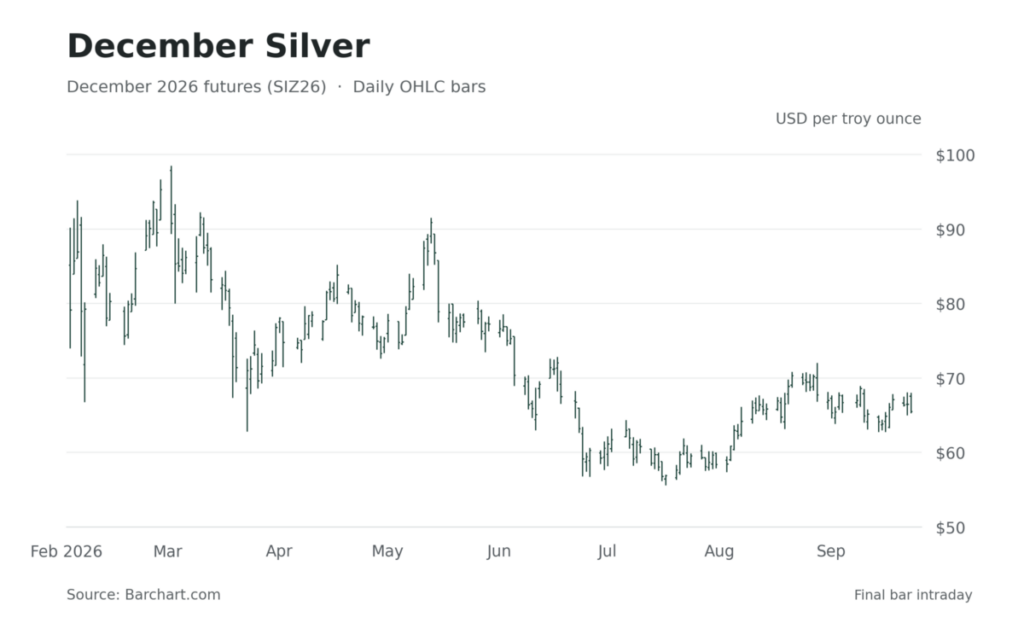
December Silver has traded considerably lower since the short squeeze rally last winter.
We see the Fed and industrial outlook working against a sustained advance through the remainder of 2026. Remember, as an option seller, you don’t have to predict exactly what price is going to do, only what it is less likely to do. Selling calls well above the market can leave room for silver to rise and still allow those calls to expire out of the money. A weaker dollar or renewed investment buying could test that judgment.
However, a correction in silver accompanied by higher option volatility could make selling puts worth considering as well. We feel precious metals in general will remain fertile ground for selling both puts and calls in the coming months.
For investors who prefer to limit the risk of a call sale, a credit spread pairs the call sold with a higher-strike call purchased on the same futures contract and expiration. The second option reduces the premium collected but also limits the intact spread’s maximum loss at expiration to the distance between the strikes, multiplied by the contract size, less the net premium received, before costs.
Risk Disclosure: Trading futures and options on futures involves substantial risk of loss and is not suitable for all investors. Certain option-writing strategies, particularly uncovered positions, may involve substantial or potentially unlimited losses. Adverse market movements may also result in increased margin requirements and the need to deposit additional funds. OptionSpreaders.com utilizes spread-based strategies intended to offset or limit certain risks, but spreads do not eliminate the possibility of substantial loss. Investors should carefully consider whether these strategies are appropriate in light of their financial condition, investment objectives and ability to bear risk. Past performance is not necessarily indicative of future results.
Justin Cardwell is President of OptionSpreaders.com, a commodity trading advisory firm specializing in commodity option selling. At the time of writing, accounts managed by OptionSpreaders.com hold short positions in silver call options. These positions may change.
Benzinga Disclaimer: This article is from an unpaid external contributor. It does not represent Benzinga’s reporting and has not been edited for content or accuracy.

Login to comment