Investment Thesis
This recent pullback in Celestica Inc. (NYSE:CLS) stock, caused by a massive $3B Secondary Public Offering (SPO) — which involved a significant discount on the shares offered –, gave investors an attractive entry point to buy this promising asset. Market focus on the dilution of shareholders’ equity is a short-term issue, but in the long term, it remains relevant to continue strengthening the company’s moat.
Now, looking at the rapid expansion of the CCS segment, with record revenue and an operating margin of 8.7%, it’s clear that Celestica’s leadership continues to strengthen. And that allows the company to continue its transition to becoming an AI infrastructure systems integrator. Moreover, significant PEG discount and revenue growth while maintaining the EV/Sales multiple suggest a potential 65% increase in the company’s value over the next 12–18 months.
Growth in the CCS Segment Strengthens Celestica’s Moat
Celestica’s strategy is centered on transforming its previous business model, which saw the Connectivity & Cloud Solutions (CCS) and Advanced Technology Solutions (ATS) segments account for approximately 60% and 40% of revenue, respectively. Starting in 2023, with the onset of the AI supercycle, that ratio began to shift in favor of the CCS segment, which is a sign of the parabolic growth in demand for server equipment.
In Q1 2023, according to the data, revenue in the ATS segment totaled $792M, compared to $1.045B in the CCS segment. Still, over time, the electronics segment is becoming less significant relative to networking equipment, necessary for data center operators, cloud providers, and hyperscalers. According to data for Q2 2026, revenues from the ATS segment increased only to $888M, whereas the CCS segment reached a record $3.81B. Moreover, compared to the operating margin figures by segment, we should note the clear advantage of CCS over ATS (8.7% vs. 6.3%, as of Q2 2026).
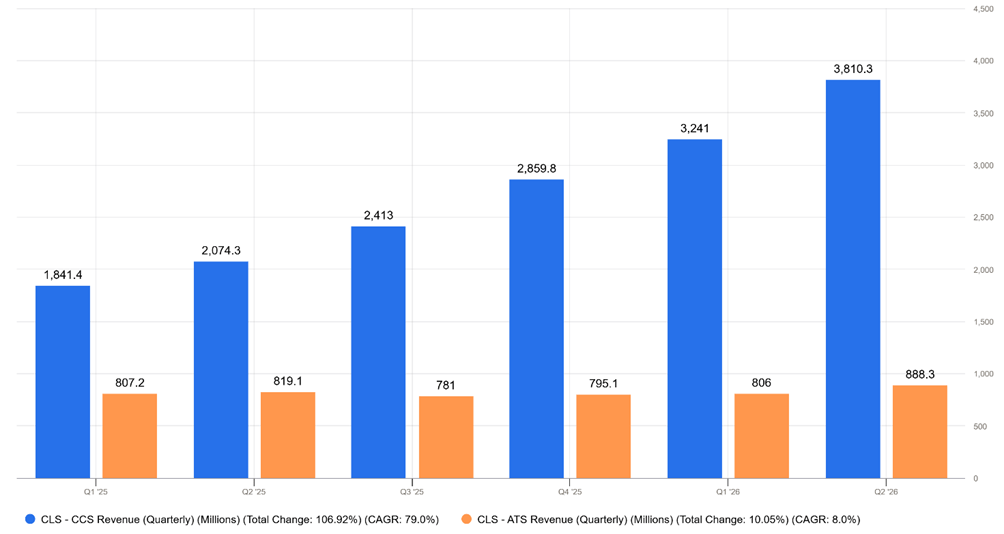
I believe that the focus on the CCS segment will continue to grow, since network equipment manufacturing supports the operation of cloud applications and AI models. Within its product portfolio, Celestica is also expanding its offerings in the high-speed network switches and data storage systems subsegments. These moves help strengthen Celestica’s competitive moat, because they enable the company to offer increasingly comprehensive services to customers, which are tailored to their individual needs.
However, there is a fly in the ointment: Celestica is facing increasing competition from diversified Asian players that offer similar service portfolios. They include Foxconn, the leader in the AI server segment (working closely with Nvidia), along with the Taiwanese giant Quanta Computer, working with hyperscalers such as Microsoft, Alphabet, and Meta Platforms. Therefore, one of Celestica’s strategic moves is to seek new partners among these giants, enabling it to bring new, meaningful products to market.
The most significant example is the new partnership with AMD (announced on March 16, 2026), enabling the launch of the Helios AI platform, a computing solution that uses the entire rack as its basic unit (volume production is expected in early 2027). Further implementation of the plans listed above should help Celestica strengthen its role as a provider of full-rack solutions. Apart from AMD, the management announced during the most recent conference call a partnership with OpenAI (OPENAI), which the company plans to begin supplying with specialized racks.
The Phenomenon of Repeated Forecast Upward Revisions for 2026–2027
Celestica recorded another increase in revenue in Q2 2026 (+62% YoY), achieving $4.7B. The adjusted operating margin for the year rose from 7.4% to 8.2%. In light of strengthening customer demand and the partial resolution of previous component supply issues, management increased its previous full-year revenue forecast for 2026 from $19.0B to $20.5B, along with an adjusted operating margin forecast from 8.1% to 8.4%. In addition, ongoing implementation of new projects (most notably in collaboration with AMD and OpenAI) will drive revenue growth in 2027 as well.
Consensus forecasts from analysts predict that annual revenue growth in 2027 will be 72.4% (revenue growth of 65.94% is expected in 2026), increasing the figure to $35.45B. Even though this growth will slow down starting in 2028, revenue is projected to reach $70.55B by 2030.
A Large-Scale SPO Worth $3B: Necessity or Mistake?
Looking at the reasons behind CLS’s decline in value over the past quarter, one thing worth mentioning right away is the large-scale SPO announced on August 5, 2026. The quarterly report indicates that the number of shares outstanding at the end of Q2 2026 was 115.0M. Within the framework of the $3B SPO, a further 9.677M common shares were issued at a price of $310. One day before the offering, at the market close, share price stood at $362.76, then dropped to $314.53 the following day. The significant decline in market capitalization was due to a discount of more than 14% in the pricing of the recently issued shares relative to the market value at the time of the SPO.
Considering that the number of shares outstanding automatically increased from 115.0M to 124.677M, share dilution amounted to 8.41%. Moreover, in the context of this SPO, Celestica additionally granted the underwriters an option to purchase 1.451M common shares. Thus, share dilution could potentially increase to 9.68%.
Certainly, the terms of the SPO represented a steep discount to the current value of CLS shares, resulting in bearish pressure. This significant dilution of shareholders’ equity in a single transaction caused a wave of profit-taking among institutional investors, which led to a sharp price correction. But the negative impact of this news ends there, plus it’s already old news that won’t increase selling pressure, neither in the short term nor in the long term.
However, analyzing the reasons behind this transaction, its great importance for maintaining the business’ previous growth rate should be highlighted. The management of Celestica has confirmed the need to raise additional funds ($536M as of Q2 2026), the proceeds of which will be used to finance CapEx (spending is projected to rise to $1B in 2026) and replenish working capital. Given that customer demand is showing parabolic growth, the company’s operational capabilities must be scaled up through investments in fixed assets. Doing so will enable Celestica to realize its corporate goals of consolidating its leadership in the server equipment market. The reasons for raising these funds also include the realization of new projects with AMD and OpenAI.
CLS Valuation
To analyze the attractiveness of CLS stock, let’s take a look at the forward PEG, EV/Sales, and EV/EBITDA ratios relative to other competitors: Jabil Inc. (JBL), Flex Ltd. (FLEX), Sanmina Corporation (SANM), and Plexus Corp. (PLXS).
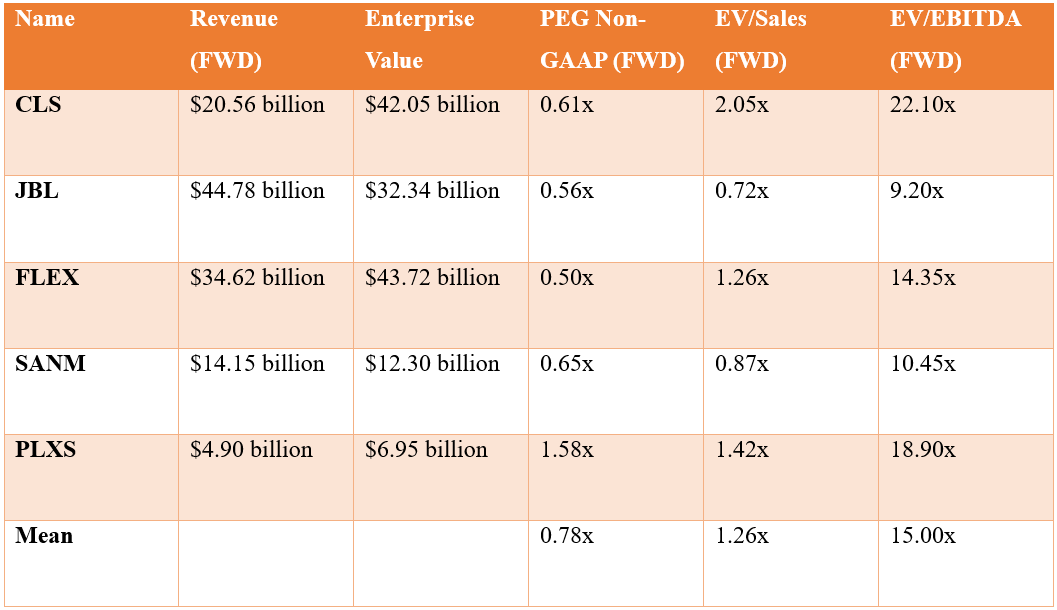
These are the average multiples: 0.78x, 1.26x, and 15.00x. As a result, CLS is trading at a 21.8% discount based on Non-GAAP PEG (FWD), whereas based on EV/Sales (FWD) and EV/EBITDA (FWD), their shares are trading at premiums of 62.7% and 47.3%, respectively.
But when lumping CLS together with its competitors listed above, we should keep in mind the fundamental difference between the companies themselves. This is because virtually all of its competitors trade at lower multiples but lack the competitive moat that CLS possesses. With regard to Celestica, the company is a market leader and is expanding its roster of strategic partners. In addition, its comprehensive suite of services for organizing AI clusters in the CCS segment is also expanding.
Based on the results for 2027, revenue is expected to grow to $35.45B, which I believe will keep the EV/Sales multiple around 2.00x as operating margins continue to rise. Thus, using this multiple on the projected revenue, the projected valuation of the business is estimated to grow from the current $43B to $71B. Based on current stock prices, that implies a 65.1% upside potential over the next 12–18 months.
According to Wall Street estimates, analyst consensus forecasts indicate an average price target of $473.91, suggesting a 27.02% increase. Out of 22 Wall Street analysts, everyone has a positive rating on the stock (17 at “Strong Buy” and 5 at “Buy”). Recently, for example, the analysts at UBS revised their neutral rating, increasing it from “Hold” to “Buy” with a target price of $430. Their main reason for the revision is an upward revision of forecasts for the CCS segment, showing that Celestica’s management strategy to increase the share of full-rack solutions is on the right track.
Supply Chain Disruption Risks
Like before, I think that potential supply chain disruptions remain the main risk for Celestica. Company management also mentioned this during their latest conference call. These disruptions could lead to delays in the delivery of certain components needed to build complete solutions. One negative consequence of this could be the deferral of revenue to subsequent quarters, resulting in volatility in financial metrics in future quarterly reports.
But this risk was already known based on the results of Q1 2026. The result was that revenue exceeded forecasts, but operating margins, actually, improved. The main reason for this is Celestica’s partnership model with its customers, which shifts most of the costs onto the customers themselves. These factors reduce pricing risks and help maintain the positive trend of growing operating margins. As a result, whereas last time I would have rated this risk at 6 out of 10, now I am lowering its significance to 4.
Conclusion
Thus, CLS’s recent correction is temporary, because the company maintains strong fundamental momentum, which allows us to reaffirm its “Buy” rating. The $3B raised will be used to scale Celestica’s operational capabilities, helping it solidify its position as a market leader. Its plans with AMD and the new partnership with OpenAI provide an opportunity to increase sales in the CCS segment, with a record operating margin of 8.7%. Based on my valuation of CLS shares, I forecast a 65% upside potential for the company’s value, in line with the high valuations from Wall Street.
Analyst’s Disclosure: I have a beneficial long position in the shares of CLS either through stock ownership, options, or other derivatives. I wrote this article myself, and it expresses my own opinions. I am not receiving compensation for it. I have no business relationship with any company whose stock is mentioned in this article.
Benzinga Disclaimer: This article is from an unpaid external contributor. It does not represent Benzinga’s reporting and has not been edited for content or accuracy.
Login to comment