US military operations against Iran have a broader target than merely crippling the Islamic regime in Tehran.
For the second time this year, Washington has struck two of China's key partners supplying 17% of its oil. The US-Israeli air war killed Iran's Supreme Leader Ayatollah Ali Khamenei after the US captured Venezuelan President Nicolás Maduro in a risky Caracas raid in January.
The Trump administration wants to redraw the world's geopolitical map to weaken Beijing's control over key economic chokepoints. It is using oil as a central lever to limit China's influence. The US and its allies have already taken steps to counter China's control over critical mineral supply chains.
"Those believing there's no structure behind Trump's actions were led by their disdain," Velina Tchakarova, a geopolitical strategist, wrote on X on February 28. "All flashpoints are connected dots in a strategy that aims to concentrate all efforts on China & the Indo-Pacific."
The US military is positioned to cut off energy supplies to China, a move that could slow China's GDP growth. This will challenge Xi Jinping before his expected summit with President Trump.
China Depends on Iran for Oil
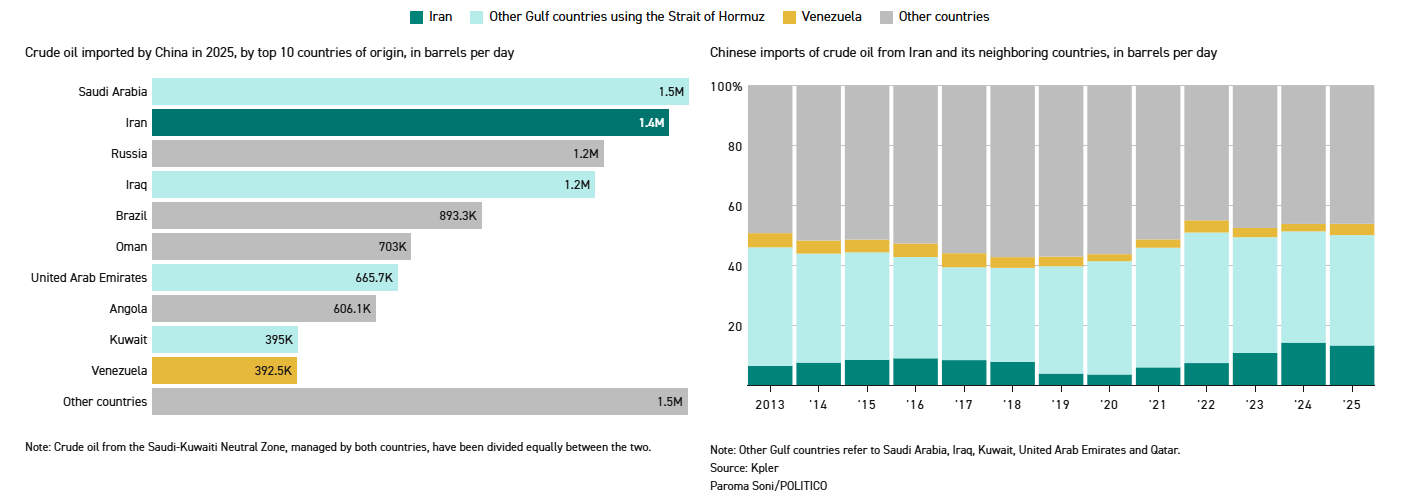
Over half of China's crude imports come from countries disrupted by the Strait of Hormuz conflict. China bought more than 80% of Iran's shipped oil in 2025, data from analytics firm Kpler showed.
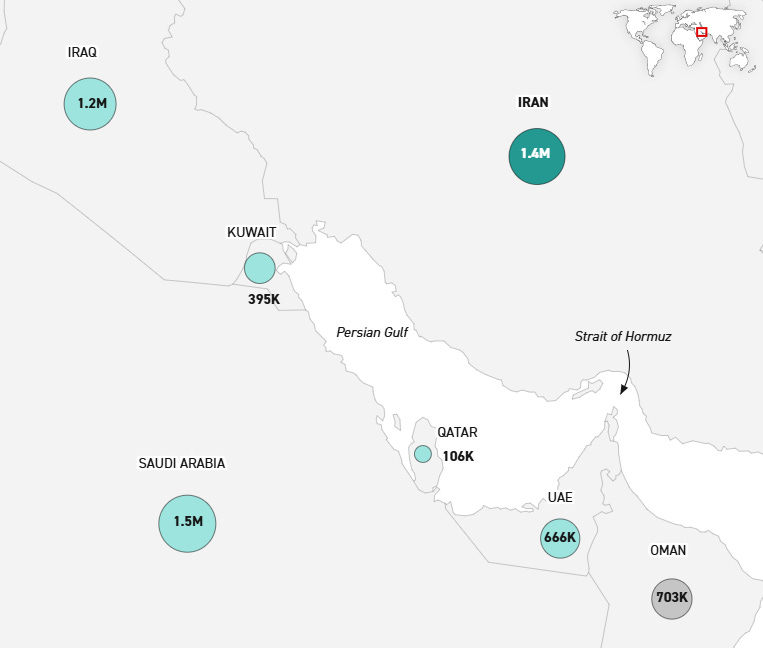
China purchased an average of 1.38 million barrels per day of Iranian oil last year, according to Kpler. That represented about 13.4% of the total 10.27 million bpd of oil China imported by sea.
Michael McNair, a fund manager, wrote on X that the Iran operations have handed Washington leverage over China's key supply chain arteries. "China built a stranglehold over critical supply chains to deter the US. But the Gulf war may have given the US a reciprocal lever over China's supply chain."
The Chinese foreign ministry spokesperson said on Sunday that the action taken by the US and Israel "tramples on the purposes and principles of the UN Charter and basic norms in international relations."
Beijing Worries About Shipping Route Closure
Iran's Revolutionary Guard Corps (IRGC) warned ships not to pass through the Strait of Hormuz, Reuters reported on Saturday. Ebrahim Jabbari, a senior adviser to the Commander-in-Chief of the IRGC, was quoted as saying that Iran would "attack and set ablaze any ship attempting to cross."
China has pressured Iranian officials to allow the passage of oil and LNG cargoes through the Strait. It has called on Tehran not to attack tankers carrying energy supplies, Bloomberg reported.
Maritime traffic through the Strait of Hormuz has nearly stopped, with no oil shipments reported in the past 24 hours, Bloomberg said. A review of shipping signals confirmed two commercial transits, the Joint Maritime Information Center said in a note on Friday.
Major global shippers, including A.P. Møller-Mærsk A/S (OTC:AMKBY) and Hapag-Lloyd AG (OTC:HPGLY), have suspended all vessels transiting through the Strait of Hormuz. They halted operations due to the regional conflict and the withdrawal of maritime insurance coverage.
The disruption "could have a negative impact on Chinese business investments in the wider Middle East," Meia Nouwens, a senior fellow for Chinese Security and Defense Policy at the International Institute for Strategic Studies, wrote on Tuesday.
China Cuts GDP Target Range
The war against Iran will compound China's economic headwinds after it reported its slowest expansion goal since 1991. China has cut its annual economic growth target to a range of 4.5%–5%.
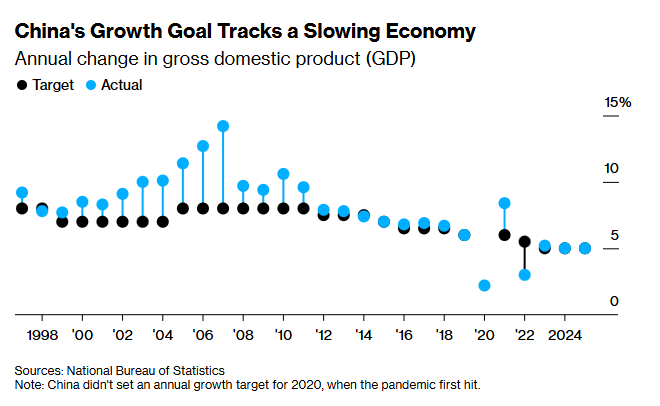
Weak spending, a property slump, and declining birth rates have weighed on China's economy. US tariffs have added pressure to China's export-reliant economy, the second largest in the world at $20 trillion.
Chinese Premier Li Qiang mentioned on Wednesday the economic impact from the US "tariff shock." He said that new stimulus measures implemented last year had helped cushion the blow.
Alongside tariffs, US–Israeli operations have cut off two of Beijing's oil suppliers. Though China can diversify imports, losing Iranian oil will sharply raise costs. Analysts say this will tighten margins for China's manufacturing base, on which its economy heavily depends.
US Challenges Beijing's Strategy
China has not only needed Iran for energy supplies. Tehran has played an important role in Beijing's geopolitical positioning, one designed to demonstrate the limits of US power.
"Beijing needed a defiant Tehran to keep Washington pinned down in the Gulf, to sustain a sanctions-proof energy corridor, and above all, to stand as living evidence that American power had hard limits," Zineb Riboua, a Hudson Institute research fellow at the Center for Peace and Security in the Middle East, wrote on Wednesday. "Ayatollah Khamenei was the man who made that thesis feel real."
Henry Wang, president of the Centre for China & Globalization, told CBS News that China's supply line will be seriously impacted by what he called a "manmade crisis." However, he also argued that the US would feel the brunt of its own actions.
"I think President Trump is doing self-harm," Wang said. "It hurts European countries, it hurts G7 countries, and it hurts the US as well. Not just China—the whole global economy. We're not living in an isolated environment. It's all intertwined."
Trump will travel to China for a summit with Xi at the end of the month. The war in Iran adds a new layer of tension to the already fraught relationship between the world's two largest economies.
Disclaimer: Any opinions expressed in this article are not to be considered investment advice and are solely those of the authors. European Capital Insights is not responsible for any financial decisions made based on the contents of this article. Readers may use this article for information and educational purposes only.
Benzinga Disclaimer: This article is from an unpaid external contributor. It does not represent Benzinga's reporting and has not been edited for content or accuracy.
Login to comment