It was the week the war in Iran almost ended — and then almost didn’t.
With one hour to spare before an 8 p.m. Tuesday deadline, during which President Donald Trump had threatened that “a whole civilization will die tonight, never to be brought back again,” he announced a two-week ceasefire with Iran.
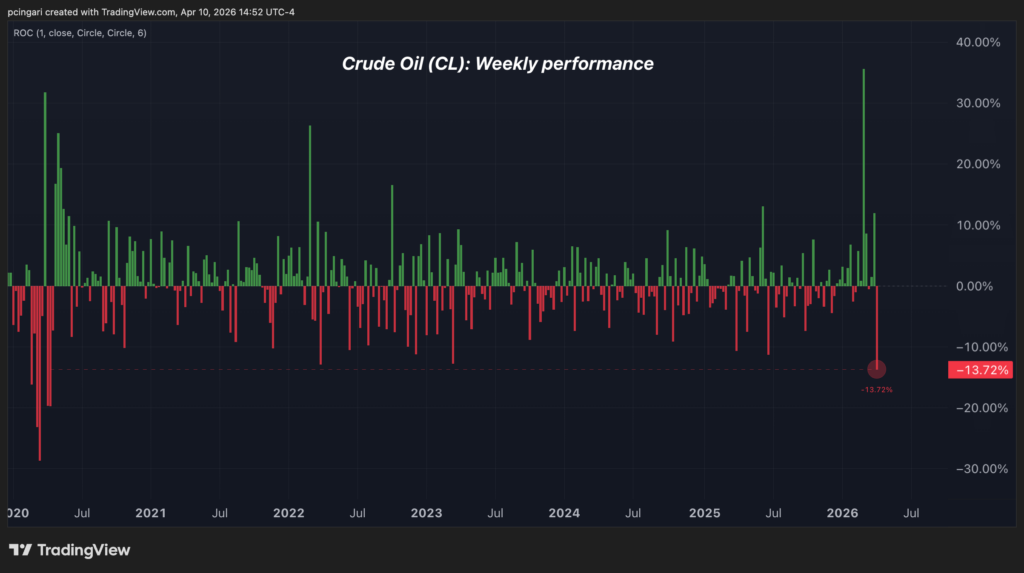
Oil fell 17% on Wednesday — its biggest single-day drop since April 2020. Crude – as tracked by the United States Oil Fund (NYSE:USO) – traded at $96 per barrel by Friday, down 13.7% on the week, its worst weekly decline in six years.
For a brief moment, the pump price nightmare that had defined the past six weeks looked like it might finally be over. It wasn’t.
Israeli strikes in Lebanon followed the ceasefire announcement and Iran responded by closing the Strait of Hormuz again, and oil flows halted once more.
The week’s hard data captured the war’s damage.
On Friday morning, the government reported that consumer prices rose 0.9% in March — the steepest monthly jump since June 2022 — driven almost entirely by a 21.2% surge in gasoline, the largest single-month increase since federal records began in 1967.
The national average for regular gasoline stood at $4.153 on Friday, up 39% from $2.98 the day before the war started.
Shortly after the inflation report, the University of Michigan reported that consumer confidence had collapsed to 47.6 in April — an all-time record low, and a sharp miss against Wall Street’s forecast of 52.
Chart: US Consumer Confidence Plunges to Lowest Level Since Survey Began in 1953

Joanne Hsu, director of the university’s Surveys of Consumers, said consumers are “very, very frustrated by the persistence of high prices” and are “feeling very weighed down with the cost of living.”
Year-ahead inflation expectations jumped from 3.8% to 4.8% in a single month, the largest one-month surge since April 2025.
Despite the grim economic backdrop, markets rallied as the ceasefire announcement ignited a broad risk-on move.
The S&P 500 – as tracked by the SPDR S&P 500 ETF Trust (NYSE:SPY) – gained 3.9% on the week, its best weekly performance since May 2025.
The Nasdaq 100 – tracked by the Invesco QQQ Trust (NASDAQ:QQQ) – rose past 25,000
Michigan-based carmakers also rebounded. General Motors Co. (NYSE:GM) rallied over 6% on the week, marking its best week since late 2025. Ford Motor Co. (NYSE:F) rose 5% on the week.
Not every sector shared in the optimism.
Software stocks – tracked by the iShares Expanded Tech-Software Sector ETF (NYSE:IGV) – had their worst week in years as artificial intelligence continued to pressure legacy enterprise valuations.
ServiceNow Inc. (NASDAQ:NOW) plunged 18% — its worst week since 2016 and the worst performance in the entire S&P 500.
Photo: BLACKDAY / Shutterstock
Login to comment