SanDisk Corp. (NASDAQ:SNDK) began life as a public company as an afterthought — a storage spinoff few investors wanted.
Sixteen months later it is one of the market’s most explosive momentum trades and the analysts covering it keep raising the bar.
The stock is up over 5,000% since it split from Western Digital Corp. in February 2025. It added about 8% Thursday to roughly $1,818.
A $10,000 stake at the spinoff would be worth more than $500,000 today. That’s not a typo.
Despite the explosive rally, Bank of America Corp. is not calling the top. This week the bank’s analyst Wamsi Mohan reiterated a Buy rating and lifted its price objective from $1,550 to $2,100.
This means he sees another nearly 20% surge from the current levels.
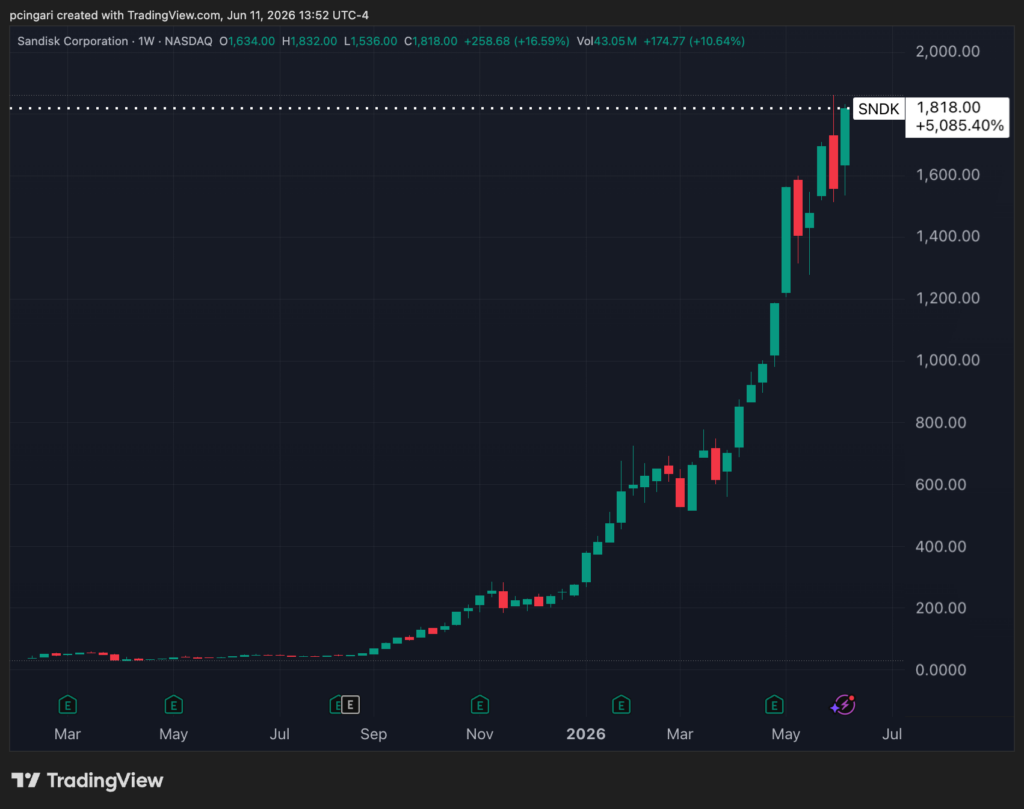
This Analyst Raised SNDK Stock Target After A 50-Fold Run
The case rests on memory pricing.
SanDisk makes NAND flash, the storage that holds data inside phones, laptops and the vast solid-state drives packed into artificial-intelligence data centers.
Demand for that storage is outrunning supply. Mohan expects prices to keep climbing through 2026 and into the first half of 2027, with meaningful new industry capacity unlikely before 2028 or 2029.
The result is an earnings explosion.
Bank of America now models fiscal 2027 revenue of $44 billion and earnings of about $188 a share, up from prior estimates of $37.7 billion and $154. Fiscal 2026 revenue alone is set to grow 176%.
The Contracts Locking In SanDisk’s Boom
The more durable part of the story is how SanDisk is selling that supply.
The company has signed what it calls new business models — multi-year contracts that fix prices for an initial period, then shift to variable pricing, structured so margins stay within guidance even at the floor.
SanDisk has signed five so far.
Three carry minimum contractual revenue of $42 billion. Together the agreements include financial guarantees above $11 billion plus $400 million in prepayments. More than a third of fiscal 2027 revenue is already committed.
Analyst Wamsi Mohan called the arrangements “win-win as they lock in committed supply for customers” while guaranteeing revenue for SanDisk.
There is a defensive angle too. With its improved margins, SanDisk can now cut production if demand softens rather than churning out wafers just to raise cash, as it once had to.
A Valuation That Gets Cheaper As The Stock Climbs
Here is the paradox. Even after a near 50-fold run, the stock does not screen as expensive on forward numbers.
SanDisk trades at about 23 times this fiscal year’s expected earnings and roughly 8 times the following year’s, because profits are growing faster than the share price.
BofA’s $2,100 target is built on about 10 times its 2027 earnings estimate.
The risk is the same one that has ended every memory cycle before it.
BofA’s top downside scenario is a sharp drop in NAND prices from oversupply, followed by competition from Chinese suppliers and slower adoption of AI-enabled consumer devices.
Memory is cyclical. Booms this steep have reversed before.
Where The Rest Of The Street Stands
Bank of America is even not the most aggressive voice on SanDisk.
According to Benzinga Analyst Rating, Cantor Fitzgerald carries a $2,900 target and Susquehanna sits at the Street high of $3,250.
Mizuho is at $2,200, Barclays recently lifted SanDisk to Overweight at $2,300 and Citigroup is at $2,025.
Yet the average price target across all analysts is just $1,319.27 — below where the stock trades.
The question now is whether the contracts SanDisk has locked in are enough to break memory’s oldest pattern.
Every prior boom convinced investors this time was different. SanDisk says the contracts make it so.
Image: Shutterstock
Login to comment