Two weeks ago, traders on X and on Reddit were posting “even Saylor is selling now.” Bitcoin (CRYPTO: BTC) had broken below $60,000 for the first time since the 2024 election, wiping $160 billion in crypto market value in a few days. The Fear and Greed Index hit single digits. The kind of panic that doesn’t leave so quickly.
Today, BTC is back at $66,000. Leverage has been flushed. ETF inflows have quietly turned positive. Whale wallets are pulling coins off exchanges. so, by most measures, the bounce looks real.
But there’s something else that the price chart doesn’t show: the story that held Bitcoin together for years just cracked. And BlackRock’s answer to that crack launched on Nasdaq this morning. Those two things, taken together, tell you more about where Bitcoin goes from here than any technical indicator.
The 32 Coins That Shook a $2 Trillion Market
On June 1, Strategy disclosed it had sold 32 Bitcoin between May 26 and May 31 to cover preferred stock dividends. The proceeds were about $2.5 million. But look at the company’s total Bitcoin position: 843,706 coins worth over $60 billion. That’s 0.0038% of their holdings, the kind of number that shouldn’t move anything. Less than a rounding error.
However, it moved everything.
Bitcoin dropped 14%. ETF outflows hit $4.3 billion across 12 consecutive sessions, a record streak. More than $800 million in leveraged positions got liquidated in a single day. And Strategy’s own stock fell nearly 6%.
None of that happened because just 32 coins changed the supply picture. Think of it like a bank run. Banks don’t collapse because everyone withdraws their money at once for rational reasons. They collapse because people stop believing the bank will be fine. The moment that belief cracks, it becomes self-fulfilling.
That’s what happened here. Since 2020, Strategy’s entire value to the Bitcoin market wasn’t just the 840,000 coins it held. More than that. It was the certainty that Saylor would never sell them. Every Bitcoin holder, consciously or not, was pricing in that promise. When it cracked, even by just 32 coins, the market didn’t reprice the coins. It repriced the whole belief.
And that belief doesn’t snap back in ten days. Saylor himself has said on a podcast that selling more this year is “not unlikely.” Prediction markets, which previously priced Strategy sales as nearly impossible, now treat them as near-certain. That’s a different company than the one the crypto world held in its head for five years.
The price recovered. But the certainty didn’t.
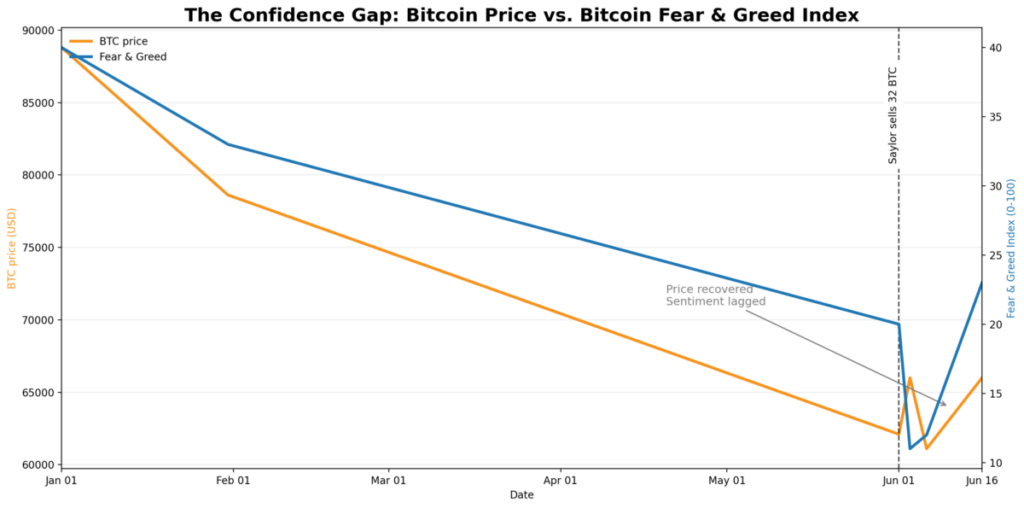
This chart shows the gap between Bitcoin's price recovery and the market's mood. BTC bounced back after the early-June drop, but the Fear and Greed Index stayed weak, showing that confidence lagged behind price even as the market stabilized. The vertical marker for Strategy's 32 BTC sale shows the moment sentiment cracked, and the chart makes the point that Bitcoin recovered faster than traders' trust did.
What BlackRock Built in Response
This morning, BlackRock listed the iShares Bitcoin Premium Income ETF on Nasdaq under the ticker BITA. And the timing is either very brave or very smart.
BITA is not a spot Bitcoin fund. It holds BlackRock’s own IBIT exposure and sells call options against roughly 25% to 35% of the portfolio each month. The premiums from those options become monthly income payments. Target yield: 15% to 25% annually. Fee: 0.65%, lower than every comparable product from competitors.
In plain terms, BITA doesn’t need Bitcoin to go up to pay investors. It takes Bitcoin’s volatility, the very thing that has scared away a whole class of buyers, and turns it into a paycheck. Think of it like renting out a house you own. You give up some upside if the property appreciates a lot, but you collect steady income while you wait. And if the market dips, you’re still getting paid.
The cost is capped upside. BITA targets at least 70% of Bitcoin’s price gains, not 100%. If BTC rips higher, you get most of the move. If it trades sideways or dips moderately, you still collect. Direct holders get nothing in flat markets.
BlackRock isn’t selling this to the person who already owns IBIT and wants maximum Bitcoin exposure. It’s built for the retiree who wants Bitcoin but can’t handle the swings, the income-oriented portfolio manager whose clients need monthly checks, and the institution with a yield mandate that’s been watching crypto from a distance for years.
Here’s why that changes things for the broader market. Income buyers tend to hold through volatility because they’re getting paid to wait. That’s a very different behavior from the directional speculator who panic-sells at $60,000. Over time, if BITA pulls in serious AUM, it changes who owns Bitcoin; and a holder base that gets monthly checks is a lot more stable than one that’s purely betting on price direction.
Goldman Sachs has a near-identical product coming in early July. The race to own the Bitcoin income category has started, and BlackRock just claimed first mover position.
Why Bitcoin Fell When It Did
Let’s look a one angle that hasn’t gotten enough attention: the timing of the crash wasn’t random.
Saylor himself flagged it on X. During those same weeks, roughly $400 billion flowed into AI infrastructure. Nvidia crossed $5 trillion in market cap. SpaceX completed a $2 trillion IPO. The biggest institutional money in the world was being pulled toward AI names with visible, growing earnings.
The key is that both trades compete for the same pool of capital. The major banks, hedge funds, and family offices buying Bitcoin ETFs are the same ones running big positions in Nvidia and the broader AI infrastructure trade. That pool isn’t unlimited. When AI is producing the most compelling earnings story in a decade, Bitcoin gets less of the available oxygen.
This isn’t a direct one-to-one, as in “AI went up, so Bitcoin went down.” It’s more subtle than that. Institutional investors running a fixed risk budget have a finite amount of capital to put into high-conviction bets. When one bet starts producing blockbuster results, the others get trimmed.
So Bitcoin’s next leg up isn’t just about the macro improving or leverage resetting. It partly depends on whether the AI trade cools enough to let crypto reclaim some of that institutional attention. And that’s a variable most Bitcoin analysis ignores completely.
One More Test: Warsh’s Press Conference Today
The Fed decision drops this Wednesday at 2 PM ET. A rate hold at 3.50% to 3.75% is priced at 98%+. But that part isn’t the full story.
The story is what Kevin Warsh says afterward.
Warsh is the most crypto-literate Fed Chair in history. Before he took the job, his financial disclosures showed more than 20 crypto-linked investments. He sold all of them upon confirmation, as required. He’s also a monetary hawk who inherited 4.2% inflation, and he’s signaled he may ditch the Fed’s traditional communication habits: shorter press conferences, less forward guidance, and fewer hints about rate paths.
For Bitcoin, the rate decision itself is almost beside the point. Everyone already expects a hold from the FED, so there’s no surprise there. What traders are actually watching is something called the dot plot: a chart the Fed releases every few months showing where its officials think interest rates are headed over the next two years. If that chart shows cuts being pushed further away, say into 2027 instead of later this year, it signals that borrowing stays expensive for longer. And expensive money tends to push investors away from riskier assets like crypto.
It’s worth noting that BTC has dropped after eight of the last nine Fed meetings this year, regardless of what the actual decision was. So even good news has a history of not being good enough.
Put simply: the recovery is holding at $66,000. Whether it can push through $67,000 to $68,000 resistance, or gets knocked back toward $64,000, may have a lot to do with what Warsh says in the next 24 hours.
The Bigger Picture for Bitcoin
Step back and what you see is an asset class in the middle of a transition.
The Saylor crack showed how narrative-dependent Bitcoin still is. A sale worth $2.5 million, from a company sitting on $60 billion in coins, triggered $160 billion in market losses. Not through supply and demand. Through belief. When a story breaks, the market moves first and asks questions later.
But BITA’s launch shows the other side. Once an asset gets covered-call income ETFs, the next steps historically are buffered products, structured notes, and leveraged income funds. Bitcoin is following the same institutionalization arc the S&P 500 traveled over decades, just much faster. That doesn’t make it safe, of course. But it does mean it’s getting more embedded into the everyday financial products that ordinary investors use.
The bounce from $59,130 to $66,000 is real. The supports holding it, as cleaner leverage, returning ETF flows, whale accumulation, are genuine.
But the confidence that made Bitcoin feel invincible earlier this year? That’s still being rebuilt. And that takes longer than a quick price recovery.
This article is for informational purposes only and does not constitute investment advice.
Benzinga Disclaimer: This article is from an unpaid external contributor. It does not represent Benzinga’s reporting and has not been edited for content or accuracy.
Login to comment