Two investors can look at the same number — 7.9 times earnings — and reach opposite conclusions.
One sees the cheapest SanDisk Corp. (NASDAQ:SNDK) has ever been. The other sees the oldest trap in semiconductors.
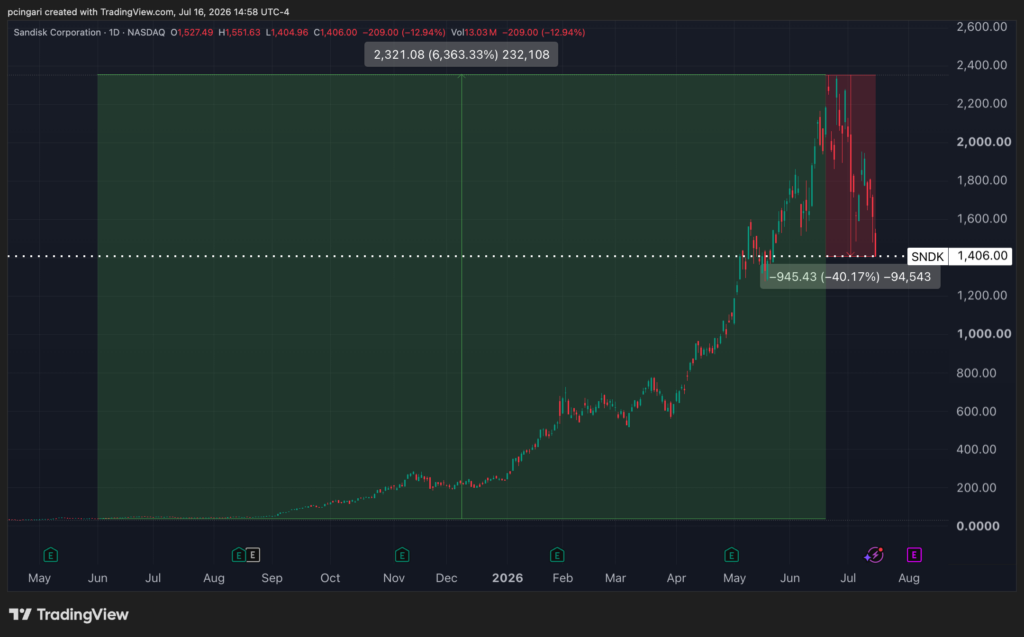
As of Thursday, July 16, SanDisk sits 39.1% below the record of $2,351.37 it set in late June, and its forward price-to-earnings ratio — the share price divided by what analysts expect the company to earn over the next twelve months, a rough measure of how expensive a stock is — has fallen to 7.9x.
Since SanDisk returned to public markets in early 2025, its average forward multiple has been 15.3x. The stock is now trading at roughly half that, pressed against 7.4x, the statistical low end of its normal range.
On the surface, that is a bargain.
Chart: SanDisk Has Plunged 40% After Historic Run
The Bull Case on SanSisk
Nothing in SanDisk’s earnings outlook has cracked. Estimates for the next twelve months have not been cut in recent days or weeks.
Wall Street is still leaning in.
The consensus rating is Outperform with an average price forecast of $1418.14, roughly where the stock currently trades, according to Benzinga Analyst Ratings data.
Bank of America analyst Wamsi Mohan hiked SanDisk’s 12-month price objective from $2,100 to $2,500 on July 1, maintaining a Buy.
“We expect supply/demand imbalance in the NAND market to remain through 2027,” Mohan wrote.
Bernstein lifted its target from $1,700 to $3,000 the day before. Citigroup went from $2,025 to $2,500 on June 25.
Mizuho and Cantor Fitzgerald both raised on June 8, to $2,200 and $2,900.
There is an implied 83.2% upside for SanDisk from these most-recent analyst ratings. Every one is a maintained rating. Not one firm has downgraded through the drawdown.
In plain terms: not enough memory is being made to meet demand, which keeps chip prices — and profits — elevated well past next year.
If these analysts are right, 7.9x is a gift.
The Bear Case Is the Same Number
Here is the problem with cheap memory stocks: they are always cheapest at the top.
NAND and DRAM chips are commodities. Prices swing on supply and demand, and so do profits, violently.
When a shortage sends chip prices to records, earnings explode, and the P/E ratio mechanically collapses even as the stock rises. The multiple looks low not because the stock is undervalued, but because the market does not believe those earnings survive.
A low P/E on peak-cycle earnings is not a discount.
September 2018: The Cheapest Stock That Wasn’t
This has happened before, in this industry, to a stock that looked just as cheap.
Micron Technology Inc. (NASDAQ:MU) had just posted fiscal 2018 earnings of $11.95 per share on a historic DRAM shortage. The stock traded at a mid-single-digit forward multiple.
Every screen in the market flagged it as deep value.
What proved wrong: memory prices rolled over.
By early 2019, consensus for the following year had been cut to $7.65 — a 36% collapse in expected profit. The stock had already lost roughly half its value from its 2018 high. The multiple had never been cheap. The earnings estimates were fake.
Bulls are buying the memory shortage. Bears are buying the calendar.
Aug. 5 – when SanDisk will report second-quarter results – is when one of them has to be wrong.
Image: Shutterstock
Login to comment