Retail investors talked up five hot stocks during the week (Aug. 17 to Aug. 21) on X and Reddit’s r/WallStreetBets, driven by retail hype, earnings, AI infrastructure momentum, and corporate news flow.
Moderna Inc. (NASDAQ:MRNA), Walmart Inc. (NASDAQ:WMT), Strategy Inc. (NASDAQ:MSTR), Broadcom Inc. (NASDAQ:CRWV), and Space Exploration Technologies Corp. (NASDAQ:SPCX), biotech, pharmaceutical, retailer, Bitcoin treasury, semiconductor, AI, and space sectors, reflected strong retail interest.
Moderna
- On Aug. 19, MRNA with Merck & Co Inc. (NYSE:MRK) announced a positive Phase 3 INTerpath-001 result for their personalized mRNA cancer vaccine, intismeran, in high-risk resected melanoma. The therapy met its primary endpoint of improved recurrence-free survival and a key secondary endpoint of distant metastasis-free survival—the first successful late-stage readout for an mRNA cancer vaccine—sending MRNA shares surging more than 177% that day. However, it was followed by a sharp profit-taking pullback on Aug. 20, with analysts raising targets and the company planning regulatory discussions.
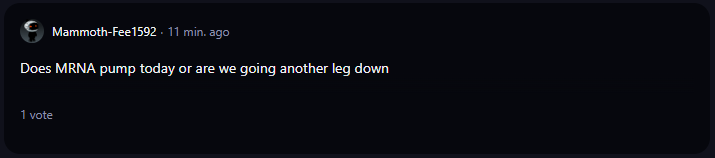
- Few retail investors were contemplating whether MRNA would rebound as it corrected after the 177% explosion.
- The stock has traded in a range of $22.28 to $176.66, trading around $132 to $139 per share, as of the publication of this article. It advanced by 395.80% over the year and 167.34% in the last six months. The stock was up 352.09% year-to-date.
- According to Benzinga’s Edge Stock Rankings, MRNA was maintaining a strong price trend over the short, medium, and long term.
Walmart
- On Aug. 20, Walmart reported fiscal second-quarter 2027 results that beat estimates with revenue of $187.9 billion, up 5.9%, and adjusted EPS of $0.81, driven by strong global e-commerce growth of 23% and advertising gains, while raising full-year sales guidance to 4–5% and adjusted EPS to $2.80–$2.87. However, U.S. comparable sales rose only 2.6%, the slowest in about six years, missing forecasts amid pharmacy headwinds and consumer caution over high fuel prices, soft third-quarter guidance, and plans to use $2.9 billion in tariff refunds for price cuts sent shares down roughly 9%.
- Retail traders were mocking WMT’s decline as it dragged all the indices down following its second-quarter results.

- The stock had a 52-week range of $95.42 to $135.16, trading around $102 to $105 per share, as of the publication of this article. It advanced by 1.24% over the year, but fell 15.57% in the last six months. The stock was down 6.79% YTD.
- Benzinga’s Edge Stock Rankings showed that WMT had a weak price trend in the short, long, and medium terms, with a solid quality score.
Strategy
- This week, MSTR disclosed in an 8-K that it sold about 3.46 million shares for roughly $334 million in net proceeds during the prior week, with no Bitcoin (CRYPTO: BTC) purchases or sales, leaving holdings steady at 840,447 BTC, allocating the funds to STRC preferred dividends, buybacks, and boosting its USD reserve to $4.8 billion; a sharp Bitcoin rally, pushing prices above $70,000–$77,000, drove MSTR shares higher and flipped the company’s BTC position back into an unrealized gain of about $1.4 billion.
- A few retail investors who missed the MSTR rally following the BTC surge were regretting their decision.

- The stock had a 52-week range of $81.81 to $365.21, trading around $111 to $124 per share, as of the publication of this article. It declined by 67.36% over the year and 14.24% in the last six months. The stock was down 26.03% YTD.
- MSTR maintains a weak price trend over the long and medium term but a strong trend in the short term, as per Benzinga’s Edge Stock Rankings.
Broadcom
- This week, AVGO shares faced pressure early on from lingering concerns over an actively exploited VMware vCenter security vulnerability and AI backlog financing. The stock then dropped after rival Marvell Technology Inc. (NASDAQ:MRVL) announced a major custom AI chip development deal with Alphabet Inc.’s (NASDAQ:GOOGL) Google, including warrants potentially linked to up to ~$120 billion in purchases, raising fears of eroded exclusivity in Google’s TPU ecosystem despite Broadcom’s existing long-term supply agreement through 2031. The stock later stabilized as analysts downplayed the competitive threat amid Broadcom’s strong AI revenue momentum, with the company also promoting its VMware Explore 2026 event.
- While most retail investors had a bearish view on AVGO, some were confident about AVGO’s trajectory.

- The stock had a 52-week range of $287.17 to $495.00, trading around $363 to $370 per share, as of the publication of this article. It rose by 25.02% over the year, 9.43% over the last six months, and higher by 5.18% YTD.
- According to Benzinga’s Edge Stock Rankings, AVGO was maintaining a strong price trend over the long term but a weak trend in the short and medium terms, with a poor growth score.
SpaceX
- SPCX shares rallied early this week on institutional ownership disclosures, with heavy stakes from Alphabet, Nvidia Corp. (NASDAQ:NVDA), and others. Recent Falcon 9 launches and momentum reclaiming near its IPO price also aided, but it faced pressure mid-week from competitive news about China’s LandSpace reusable rocket landing and anticipation of dilution. The key event was the Aug, 20 unlock of roughly 319 million shares, which added supply and sent the stock lower.
- Most retail investors were highly bearish on SPCX stock this week.

- The stock has traded in the range of $104.83 to $225.64 since listing, trading around $133 to $136 per share, as of the publication of this article. It fell by 10.67% since listing, up 11.81% over the last month, and down 5.16% in the last five trading sessions.
- According to Benzinga’s Edge Stock Rankings, SPCX was maintaining a weak price trend over the short, medium, and long terms.
Retail focus comprised AI infrastructure momentum, earnings, and corporate news-driven narratives with broader market action during the week.
Image via Shutterstock
Login to comment