Economist Robin Brooks said the Treasury market’s underlying dynamic is more troubling than investors realize, arguing that yields have kept climbing even as U.S. data has surprised to the downside, a disconnect signaling unusually weak demand for Treasury debt.
‘More Worrying Than You Think’
In a Substack post published Tuesday, Brooks tracked how U.S. economic data has performed against expectations over the past month, and found it’s been coming in weaker than forecast more consistently than usual.
“The underlying dynamic in the Treasury market is worse than meets the eye,” he said.
That weakness included a disappointing July jobs report, soft retail sales, and a particularly weak August reading of Chicago PMI, released just before Federal Reserve Chair Kevin Warsh‘s Jackson Hole speech last month.
When data comes in weak, investors expect slower growth and lower inflation ahead, which would push Treasury yields down, but Brooks found the opposite happened this time: the 10-year Treasury yield has instead climbed to 4.8%, its highest level since January 2025, while the 30-year yield hit 5.31% in August, its highest since June 2007.
“Markets are more focused on the trajectory of the deficit,” Brooks said, arguing yields are being pushed up by fiscal concerns “regardless of what data surprises are doing.”
Markets Pricing in Real Chance of a September Hike
Prediction markets raised their odds of a Fed hike this month after a stronger-than-expected August jobs report showed the economy added 162,000 jobs, far above the 65,000 expected. Polymarket puts the odds at 50%, Kalshi at 73% before 2027, and CME FedWatch at 59%.
Attention now turns to Friday’s inflation report.
What Warsh Said At Jackson Hole
At Jackson Hole, Warsh said the Fed’s 2% inflation target remains “a firm, fixed target” and policymakers’ “predominant focus right now should be on prices,” even as unemployment held at 4.1%. He said he would “struggle to call broad financial conditions restrictive.”
Brooks called it evidence of a “new Treasury-Fed accord” aimed at containing yields “in the face of out-of-control deficits.”
The debate comes as the national debt has surpassed $40 trillion.
Price Action: The SPDR S&P 500 ETF Trust (NYSE:SPY) closed 0.39% lower Friday at $770.19 and fell another 0.1% after hours, while the Invesco QQQ Trust ETF (NASDAQ:QQQ) rose 0.18% to close at $718.96 before slipping 0.2% in extended trading.
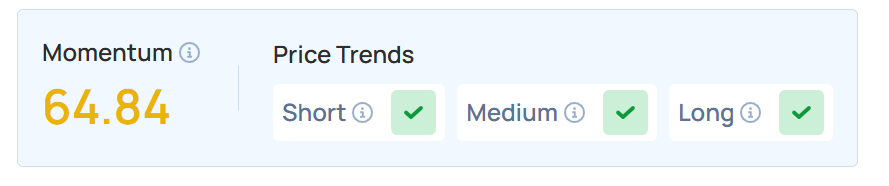
Benzinga edge rankings indicate the SPDR S&P 500 ETF Trust has a Momentum score in the 64th percentile and a positive price trend across the short, medium, and long term.
Disclaimer: This content was partially produced with the help of AI tools and was reviewed and published by Benzinga editors.
Photo courtesy: Shutterstock
Login to comment