The 30-year Treasury yield closed Friday at 5.246%, a few basis points below the 19-year high it set in August.
Traders are pricing roughly 60% odds that the Federal Reserve raises rates at its Sept. 15-16 meeting, after August payrolls came in at 162,000 against a consensus near 55,000.
Into that setup, Jordi Visser of 22V Research released a YouTube video over the weekend arguing that the bond panic dominating financial social media is a just “noise.”
His case does not rest on a forecast that yields will fall. He said they could go higher, and that a move to 5.5% on the 10-year is possible.
The argument is about what the rest of the market is doing while the yield chart climbs and about which variable actually sets the earnings power of the companies driving the index.
The Markets That Would Signal A Bond Crisis Are Quiet
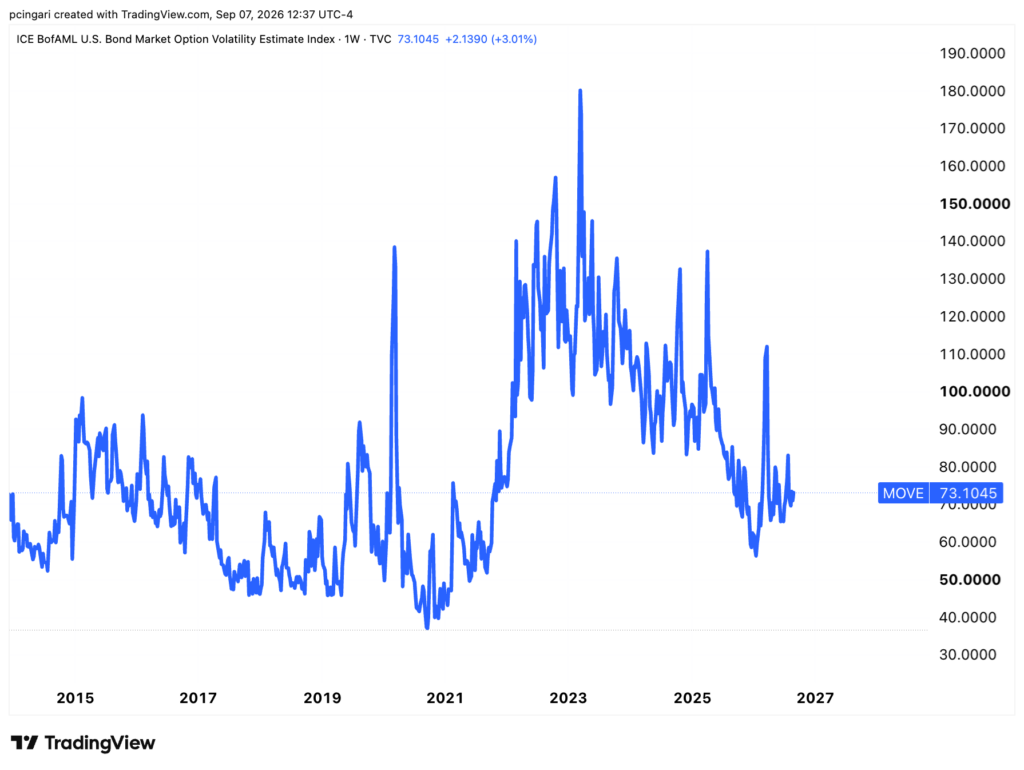
Bond volatility is subdued.
The ICE BofA MOVE index, which measures how much price movement options traders expect in Treasury futures, sat near 73 as of Friday, far below the readings that accompanied real dislocations in 2020 and 2023.
A bond market pricing a crisis does not price its own volatility that cheaply.
Credit is quieter still.
The option-adjusted spread on the ICE BofA US High Yield Index — the extra yield investors demand to hold junk-rated corporate debt instead of Treasuries — closed at 2.65 percentage points on Sept. 3.
Visser said that is among the tightest level on record, and that a market bracing for a debt crisis would not price risk that way.

Inflation expectations tell the same story.
Swaps priced one, two, five and ten years out are all clustered near 2.5%, sitting almost exactly on top of core consumer inflation, and the daily Truflation reading has been falling.
The damage is also smaller than the yield chart implies.
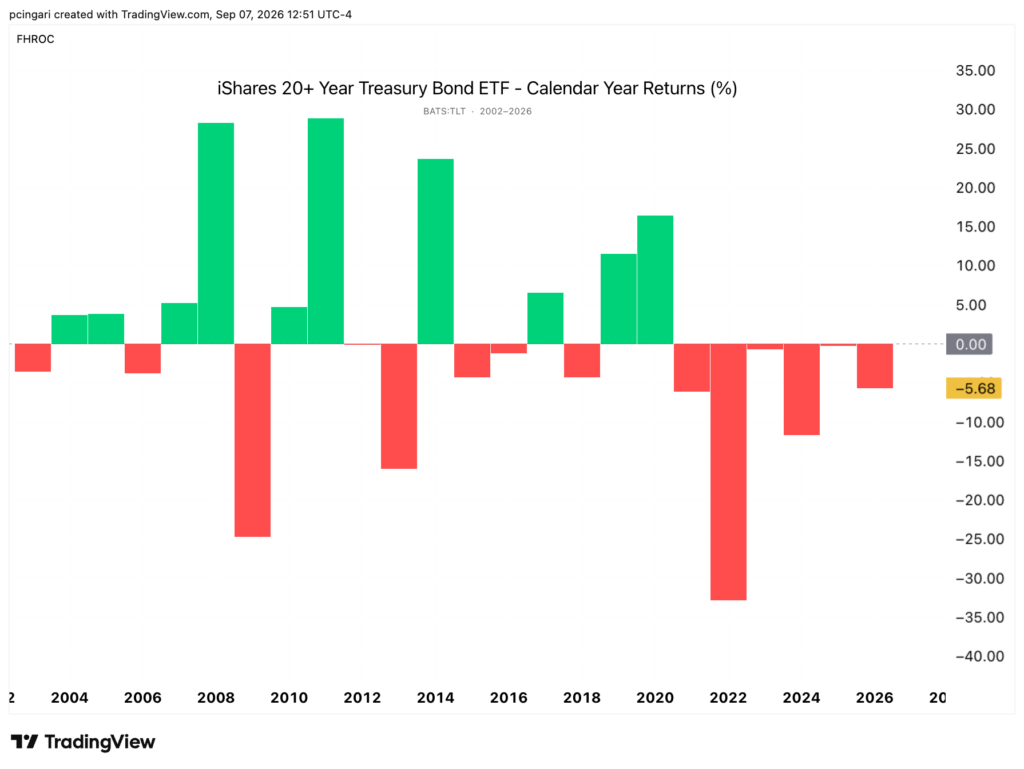
Visser said long-dated Treasuries – tracked by the iShares 20+ Year Treasury Bond ETF (NASDAQ:TLT) – are down roughly 5%, against 32% in 2022, when the bond move actually mattered.
Rates Are Not The Variable That Matters For AI
Corporate America looks anything uncomfortable.
Second-quarter S&P 500 earnings rose 50.7% year over year, or roughly 25% excluding mark-to-market gains. Analysts currently expect growth of 23.6% in the third quarter and 27.9% in the fourth.
Forward earnings reached a record $401.75 per share last week.
This is why rising yields have not yet produced the equity damage many investors expected.
“Interest rates are a rounding error on inference P&L,” Visser said.
According to Visser calculation, a 200 basis point rise in the 10-year yield, from 5% to 7%, costs the large model developers about one percentage point of margin.
A 10% cut in model pricing costs three.
The three companies that set the outcome, Visser said, are Anthropic, OpenAI and Nvidia Corp. (NASDAQ:NVDA), and the risk to watch is price compression on models, which is not happening.
The tape agrees.
Nvidia closed Friday at $230.36, within 2.6% of its 52-week high.
Dell Technologies Inc. (NYSE:DELL) jumped 9% after telling investors AI server revenue should triple, up from a doubling six months ago. Micron Technology Inc. (NASDAQ:MU) added 6.10% to $1,016.59.
Login to comment