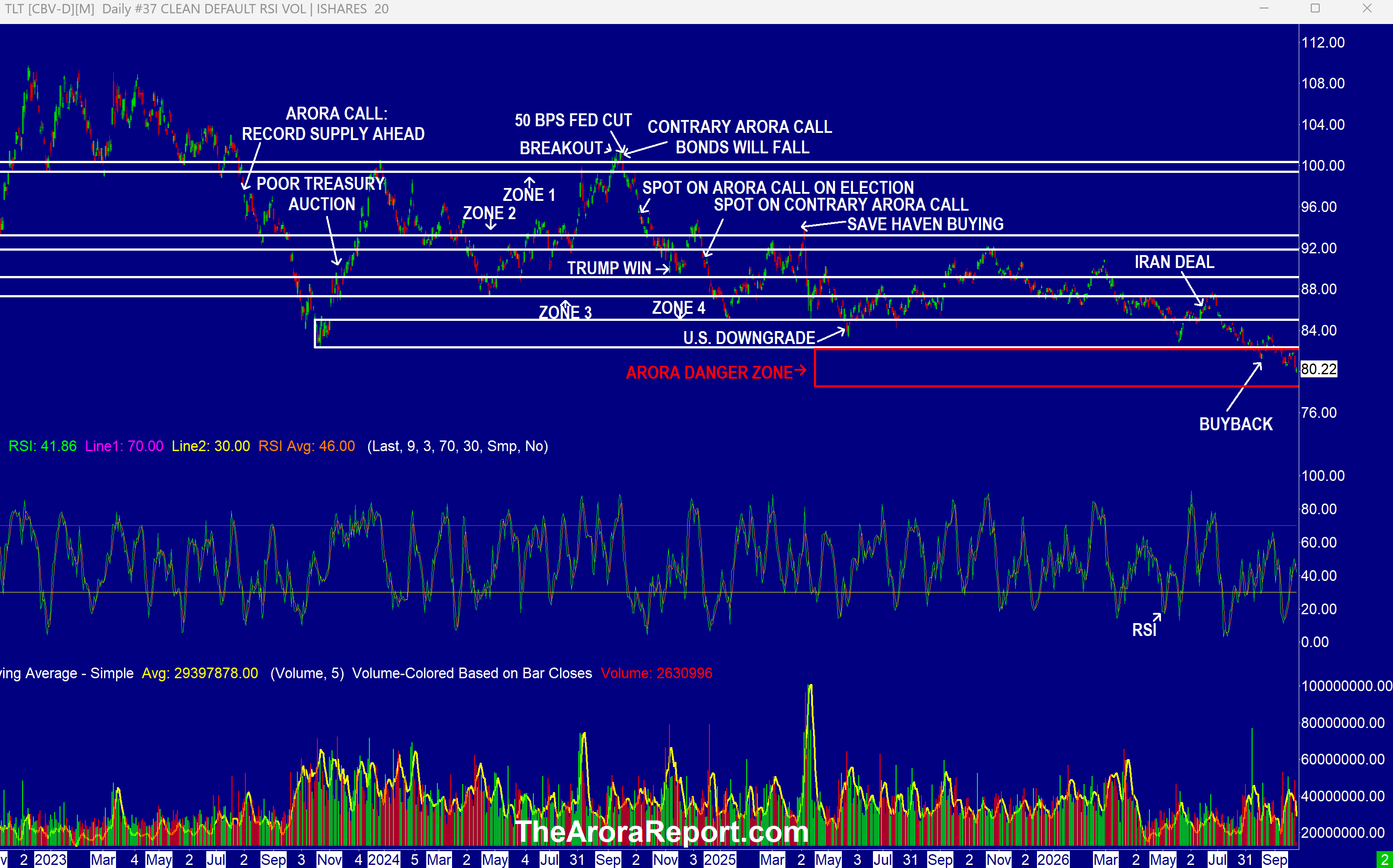
Bonds In Danger Zone
Please click here for an enlarged chart of iShares 20+ Year Treasury Bond ETF (NASDAQ:TLT).
Note the following:
- In our analysis, smart money is adjusting stock market allocations based on the move in bonds. On the flip side, the momo crowd continues to be oblivious, and momo money flows continue to indicate front running earnings season by buying AI stocks.
- Investors should carefully watch today’s $44B seven year Treasury auction.
- In our analysis, the five-year Treasury auction was weak. Here are the details:
- $70B 5 year Treasury note auction
- High yield: 5.033%
- Bid-to-cover: 2.21
- Indirect bid: 54.3%
- Direct bid: 29.9%
- Impacting bonds is the development in Japan from last week. From last week’s Morning Capsule:
- “The move in the yen is creating a policy headache for the U.S.
- Japan is a large holder of U.S. Treasuries. To protect the yen, Japan may need to sell Treasuries so that it has dollars to intervene in the forex market. Such a selling will increase yields in the U.S. Yields are already rising in the U.S. creating headaches and leading the Fed to raise interest rates for the first time since July 2023.
- There is risk to the U.S. stock market from the carry trade, in addition to the risk from rising yields emanating from Japan. In the carry trade, funds have borrowed hundreds of billions of dollars in Japan to invest in the U.S., primarily in the AI trade.”
- Japan remains the largest foreign holder of U.S. Treasuries, but its holdings have fallen to $1.104T from $1.186T at the end of 2025 and $1.239T in February. It is a $135B retreat from the peak. August country level holdings have not yet been released.
- Japan’s broader capital flow data point to Japanese investors being net sellers of foreign securities. Through August 22, Japanese investors had been net sellers of ¥3T in foreign bonds. However, the data encompass overseas debt generally and do not identify how much, if any, came from the sale of Treasuries.
- Japan does not need to dump Treasuries to drain global liquidity. Here is our analysis:
- The foregoing data should not be considered as evidence that Japan is dumping existing Treasury holdings. The important issue is the marginal buyer.
- As Japanese bond yields rise, Japanese institutions have less incentive to send the next dollar abroad.
- Japan does not need to sell its existing Treasury holdings to push U.S. yields higher. It only needs to become less willing to buy the next Treasury at the old yield.
- Higher Treasury yields increase the cost of capital and the discount rate applied to future AI earnings.
- Overnight, the yield on the 10 year Japanese bond reached its highest level since 1996.
- Initial jobless claims came at 197K vs. 202K consensus. The data indicates the jobs picture remains strong.
- From last Friday to Tuesday, the stock market ran up, in part, on oil hopium. This morning oil hopium is fading. You were ahead of the curve as we have been sharing with you that the oil hopium was premature.
- On Tuesday, we wrote:
Yields are slipping as oil pulls back. Oil is pulling back on Saudi Arabia restarting the East-West Pipeline. Prudent investors should note the pipeline is pumping at a low rate and is vulnerable to Houthi attacks.
- Overnight, Houthis fired six ballistic missiles on Saudi Arabia.
- On the positive side, President Xi is in Washington DC. The U.S. and China have extended the trade truce to January 10.
Magnificent Seven Money Flows
Most portfolios are now heavily concentrated in the Mag 7 stocks. For this reason, it is important to pay attention to early money flows in the Mag 7 stocks on a daily basis.
In the early trade, money flows are neutral in Apple Inc (AAPL).
In the early trade, money flows are negative in Amazon.com, Inc. (AMZN), Alphabet Inc Class C (GOOG), Meta Platforms Inc (META), Microsoft Corp (MSFT), NVIDIA Corp (NVDA), and Tesla Inc (TSLA).
In the early trade, money flows are mixed in SPDR S&P 500 ETF Trust (SPY) and Invesco QQQ Trust Series 1 (QQQ).
Momo Crowd And Smart Money In Stocks
Investors can gain an edge by knowing money flows in SPY and QQQ. Investors can get a bigger edge by knowing when smart money is buying stocks, gold, and oil. The most popular ETF for gold is SPDR Gold Trust (GLD). The most popular ETF for silver is iShares Silver Trust (SLV). The most popular ETF for oil is United States Oil ETF (USO).
Bitcoin
Bitcoin (BTC) is seeing selling.
What To Do Now
Consider continuing to hold good, very long term, existing positions and add tactical positions based on signals.
The Arora Report is known for its accurate calls. Most recently, The Arora Report correctly called the rally from recent stock market lows and the 2026 semiconductor decline before a 25% drop in the Semiconductor ETF (SMH). In gold, The Arora Report bought at an average price near $1,105, close to cycle lows, and took partial profits near $5,400, close to cycle highs. Don’t miss the next major market move. Please click here to get The Arora Report’s insights with the free forever Generate Wealth Newsletter.
Benzinga Disclaimer: This article is from an unpaid external contributor. It does not represent Benzinga’s reporting and has not been edited for content or accuracy.
Login to comment